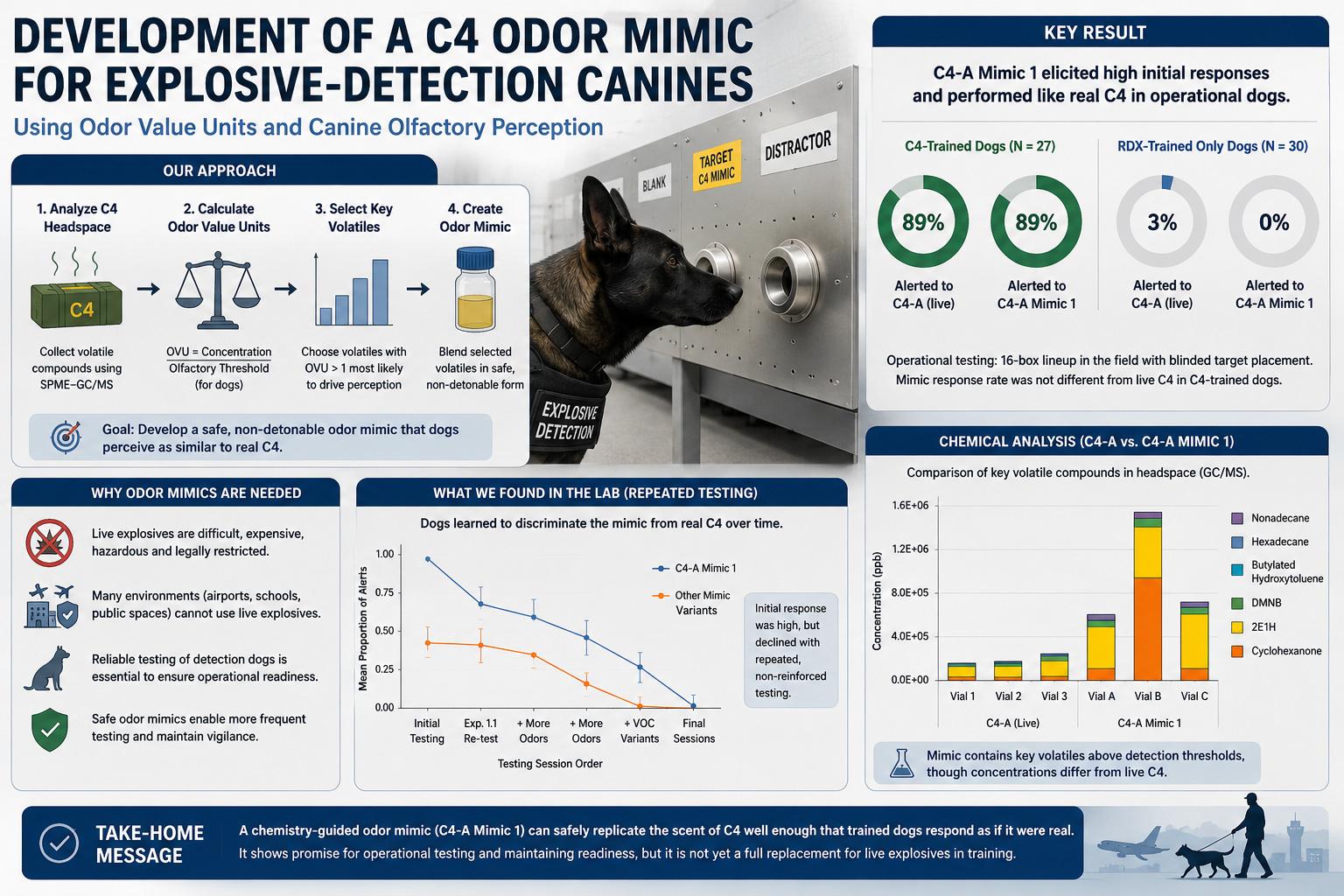
A non-peer-reviewed preprint from researchers at Texas Tech University investigates whether a non-detonable odor mimic can reproduce enough of the scent profile of C4 explosive to be useful for explosive-detection canines. The study combines analytical chemistry, canine olfactory thresholds, and dog behavior testing. Instead of choosing odor components only because they appear chemically in C4 headspace, the researchers use Odor Value Units, a food-science concept that estimates whether a volatile compound is likely to be perceptually important for the detecting species—in this case, dogs.
The paper reports that one C4-A mimic produced very high initial responses in laboratory dogs and performed similarly to live C4 in a field-style test with operational dogs already trained to detect C4. In that operational test, 24 of 27 C4-certified dogs alerted to C4-A, and 24 of 27 also alerted to the C4-A mimic. However, the mimic was not perfect: in repeated non-reinforced laboratory testing, dogs learned to discriminate it from live C4, with response rates declining over sessions. The study therefore supports the mimic as a promising tool for operational assessment or vigilance maintenance, but not yet as a proven replacement for live explosives in training.
This study addresses a difficult practical problem in explosive-detection work: the best material for training and testing explosive-detection canines is often the real explosive, but real explosives are legally restricted, logistically difficult, costly, hazardous, and unsuitable for many environments. Airports, schools, public buildings, transport hubs, and other operational settings cannot always use live explosive materials for routine canine testing. Because of this, trainers and researchers have long searched for safe training aids that smell enough like the real target to be meaningful to a dog without containing detonable energetic material.
The paper focuses specifically on C4, a plastic explosive whose detection is relevant for military, law-enforcement, and transportation-security contexts. C4 is not a single simple smell. It is a material that releases a headspace mixture of volatile organic compounds. Dogs do not detect the word “C4”; they detect airborne odor molecules. The scientific question is therefore not merely “Which chemicals are present?” but “Which chemicals are present at concentrations that dogs can actually smell, and which of those chemicals matter for the dog’s perception of the whole odor?”
The authors explain that many commercially available explosive odor mimics have not performed well. Prior work has found that dogs trained on actual explosives often do not reliably respond to pseudo-odors, and dogs trained on pseudo-odors often do not reliably generalize to the real explosive. This is a serious limitation. A training aid that smells plausible to humans, or that contains a known volatile associated with an explosive, may still fail from the dog’s point of view. For a detection dog, the only “valid” mimic is one that produces the relevant learned odor perception.
The conceptual novelty of this study is the use of Odor Value Units, abbreviated OVUs. An OVU is calculated by comparing the concentration of a volatile compound in an odor mixture with the olfactory threshold of the detecting species for that compound. In simple terms, the method asks: is this chemical present at a level the dog can detect, and if so, how perceptually important might it be relative to other chemicals? A compound with an OVU greater than 1 is above the dog’s detection threshold and may contribute to the perceived odor profile. A compound below 1 may be less perceptually salient, although mixture effects can still matter.
This approach comes from food science, where researchers have long tried to reconstruct smells and flavors by combining chemical analysis with perception. The paper gives the example of strawberries: a fruit may emit hundreds of volatile compounds, but only a smaller subset may dominate human perception. The authors apply the same broad logic to explosives detection: instead of assuming every detectable chemical is equally important, they try to identify the volatile components most likely to matter to dogs.
The study has two major experimental phases. Experiment 1 was conducted with eight laboratory dogs at the Texas Tech University Canine Olfaction Research and Education Laboratory. These dogs had prior odor training experience and were tested using an air-dilution olfactometer. Experiment 2 tested 57 operational explosive-detection dogs in San Antonio, Texas, using a field-style lineup of odor boxes. This two-layer structure is important because laboratory testing allows precise control, while operational testing asks whether the mimic works under more realistic conditions with dogs already trained for field detection work.
In Experiment 1, the dogs were trained on actual C4 variants and then tested with non-reinforced probe odors. The probe procedure is central to the study. A probe odor is presented without reinforcement so the researchers can measure spontaneous generalization. If a dog trained to C4 alerts to a mimic on first exposure, that suggests the mimic is perceptually similar to the trained C4 odor. Because the probe is not reinforced, the dog is not being taught during that trial to respond to the mimic. This helps separate true generalization from new learning.
The olfactometer setup allowed dogs to sample odor ports and alert by holding their nose in the target port for three seconds. The equipment recorded nose-port responses automatically using infrared sensors. Dogs were trained to search ports and either alert to a target odor or correctly indicate an all-clear condition when no target was present. They were gradually moved to an intermittent reinforcement schedule so that non-reinforced probe trials could be introduced without making the testing structure obvious or disruptive.
The first experiment tested whether mimics built for specific C4 variants would produce responses in dogs trained to those variants. Four dogs were trained to detect C4-A, and four were trained to detect C4-B. The researchers then tested dogs against trained C4s, untrained C4 variants, C4 mimics, other explosives, individual chemical components, and non-explosive control odors. This design asks several different questions at once: does the mimic resemble the target C4? Do dogs respond only to one chemical component? Do they simply respond to novel chemical smells? Do they generalize from one C4 variant to another?
The strongest early result was that all four C4-A-trained dogs alerted to C4-A Mimic 1 on all four probe presentations, producing a 100% response rate upon first exposure. That result suggests that this mimic captured enough of the C4-A odor profile to be treated by these dogs as the trained target odor at first encounter. However, the result was not equally successful for C4-B. Dogs trained to C4-B alerted to the C4-B mimic at only moderate rates, about 56%, and this response did not clearly separate the C4-B mimic from other C4 mimics. This difference is important because it shows that the OVU approach was promising but not automatically successful for every C4 variant.
Figure 1, on page 25, visualizes the response patterns in Experiment 1.1. The graph separates the C4-A-trained group from the C4-B-trained group and shows mean alert proportions with confidence intervals for multiple target odors, mimics, chemicals, and other explosive-related odors. The figure supports the paper’s key point that C4-A Mimic 1 produced near-perfect initial responding in C4-A-trained dogs, while other mimic-target combinations were more variable. It also shows that dogs did not simply alert strongly to every chemical or unfamiliar smell: response to phenyl ethanol, used as a non-explosive control odor, was low.
The response to 2-ethyl-1-hexanol is especially informative. This compound is one component associated with the odor profile, but dogs showed only low-to-moderate responses to it compared with the best mimic. That means the dogs were probably not responding to a single odor molecule alone. The result supports the idea that the mixture matters. This is a major lesson for odor-mimic design: a canine target odor may be a pattern of volatiles rather than one signature chemical.
Experiment 1.2 tested a mimic for another C4 variant, C4-Bofors. Four dogs previously trained to C4-B were trained to detect C4-Bofors and then tested with a C4-Bofors mimic, C4-A Mimic 1, and control distractors such as nail polish and hair dye. The dogs responded to C4-Bofors at above 95% and responded to the C4-Bofors mimic about 81% of the time. Their response to C4-A Mimic 1 increased from approximately 63% in the earlier experiment to 93% after training with C4-Bofors. This suggests that exposure to more than one C4 variant may broaden generalization.
Figure 2, on page 26, illustrates this second experiment. It compares alert rates to the newly trained C4-Bofors, the C4-Bofors mimic, the earlier C4-A mimic, and two distractor odors. The dogs responded similarly to the true C4-Bofors and the two mimics, while responding to the distractor odors at only about 5%. This pattern strengthens the argument that the dogs were responding to C4-like odor properties rather than simply alerting to unusual chemical odors.
Experiment 1.3 tested whether the successful mimic was truly indistinguishable from live C4-A. This is a stricter question. A mimic may produce a strong first response but still be different enough for dogs to learn the difference after repeated exposure. All eight dogs were trained to C4-A and then repeatedly tested with C4-A Mimic 1 across four sessions. If the mimic were perceptually identical to C4-A, dogs should have continued alerting at high rates. Instead, the response declined: dogs alerted to the mimic about 59% of the time on the first re-test and about 41% by the fourth testing session. The decline was statistically significant.
This result is one of the most important findings in the paper because it prevents overstatement. C4-A Mimic 1 was successful enough to generate high initial generalization, but it was not identical to live C4. Dogs could learn to discriminate it from the real material when it was repeatedly presented without reinforcement. In practical terms, the mimic may be useful for assessment, operational testing, or maintaining vigilance, but it cannot yet be assumed to replace live C4 in training programs.
Experiment 1.4 tried to optimize the mimic. The authors developed and tested 12 additional variations of the original C4-A mimic by changing the diluent, modifying concentrations, adding volatile compounds detected in C4-A headspace, or removing components. For safety and responsible communication, this article does not reproduce the exact formulation recipe. The important scientific point is that the researchers systematically changed the odor mixture and then measured whether dogs responded more strongly. Only one variant produced response rates above 50%, and even that was significantly lower than the initially high response to C4-A Mimic 1. Across repeated testing, responses to both the original mimic and other variants declined toward near zero.
Figure 3, on page 27, shows this decline across repeated mimic testing. The graph begins with the high initial response to C4-A Mimic 1 and then shows how responses decrease during repeated testing and across multiple mimic variants. This figure is essential because it visually captures the distinction between initial generalization and durable perceptual equivalence. The mimic can look very successful at first exposure, but repeated testing reveals that dogs can separate it from the live target.
The authors also conducted chemical analysis of C4-A and the strongest mimic using solid-phase microextraction coupled with gas chromatography-mass spectrometry. This method samples volatile compounds in the headspace and identifies them analytically. The study found several volatiles in C4-A bulk material, including cyclohexanone, 2-ethyl-1-hexanol, DMNB, butylated hydroxytoluene, hexadecane, and nonadecane. Some of these were selected for mimic creation. The chemical comparison showed that the mimic produced higher overall abundances of target volatiles than the live material and that there was variation among mimic vials, especially for cyclohexanone.
Figure 4, on page 28, presents a stacked bar graph comparing the odor profiles of C4-A and C4-A Mimic 1 for calibrated target volatiles. The figure shows that the mimic did not perfectly match the live C4-A headspace. Some mimic samples produced substantially higher apparent concentrations than the C4-A vials. This matters because dogs are sensitive not only to which chemicals are present, but also to their relative concentrations. If the ratios are off, a dog may initially generalize but later learn the difference. The chemical data therefore help explain the behavioural data: the mimic was similar, but not chemically identical in its headspace profile.
Experiment 2 moves the study from controlled laboratory dogs to operational explosive-detection dogs. The researchers tested 57 federal, state, and local law-enforcement explosive-detection dogs. Of these, 27 were certified to detect C4. The other 30 were trained to detect RDX, the main energetic material in C4, but had no known training history with live C4. This comparison is important because it asks whether RDX training alone is enough for dogs to respond to C4 or the mimic.
The operational test used two lineups of 16 odor boxes per dog. Each lineup contained one target—either C4-A or the C4-A mimic—and the remaining boxes contained distractors or blanks. Handlers and the experimenter recording responses were blind to the target location. The dogs had to search all boxes, and handlers called out alerts. This setup is closer to field testing than the olfactometer work, though still structured and controlled.
The operational results were strong for C4-trained dogs. Among the 27 C4-certified dogs, 24 alerted to C4-A, and 24 alerted to C4-A Mimic 1. This corresponds to 89% alert rates for both the live C4-A and the mimic. The response rate to C4-A and the mimic was not statistically different. Dogs alerted to both the true C4 and the mimic significantly more than to distractor odors. This is the most practically encouraging result in the paper: for dogs already trained to detect C4, the mimic appeared to function similarly to live C4 in a first-exposure operational-style test.
The results were very different for RDX-trained dogs. Of the 30 dogs trained only to detect RDX, only one alerted to C4-A, and none responded to C4-A Mimic 1. This suggests that RDX-only training did not spontaneously generalize to C4 or to the C4 mimic. That finding is operationally important because C4 contains RDX, but dogs may not treat C4 as equivalent to RDX alone. The odor profile of the complete material matters, not merely the presence of the energetic compound in the formulation.
Figure 5, on page 29, summarizes the operational dog results. The bar chart separates C4-trained dogs from RDX-trained-only dogs and compares alert rates to distractors, C4, and the mimic. The C4-trained dogs show high and nearly identical responses to C4 and the mimic, while the RDX-trained dogs show near-zero response to both. This figure is one of the clearest pieces of evidence that the mimic may be useful for assessing dogs already trained to detect C4, but it also warns against assuming that related explosive chemistry automatically produces canine generalization.
The study also reports 30 false alerts made by 17 of the 57 operational dogs. The most common distractors that received alerts were coffee, mineral oil, blank jars, and cosmetic sponges. These false alerts matter because operational detection is not only about hitting the target; it is also about avoiding false positives. The paper notes that there was not a disproportionate false-alert rate to mineral oil, the diluent used in the mimic. That supports the interpretation that the dogs were responding to the mimic’s target odor profile rather than merely to the carrier material.
Another interesting detail is that no dogs alerted to targets placed in position 1 of the lineup. The authors suggest this may be relevant for training practices. It may reflect search pattern, handler behavior, dog expectation, or the practical difficulty of first-position targets in lineups. This is not the central finding of the paper, but it shows why field-style testing can reveal operational details that laboratory apparatus may miss.
The discussion makes a careful distinction between assessment and training. The authors argue that the C4-A mimic may be useful for safely testing operational dogs in environments where live explosives cannot be used. It may also help maintain search vigilance during long deployments with low target frequency. Detection dogs, like humans, can show vigilance decrement: performance may decline when targets are rare over repeated searches. A safe target odor could potentially be planted to keep dogs engaged without introducing live explosives into sensitive environments.
However, the study does not prove that dogs can be trained from scratch on this mimic and then reliably detect live C4. The authors explicitly caution that training use must be tested separately. This is a critical limitation. A mimic that works for assessment of already trained dogs may not work as a training substitute. The direction of generalization matters. Dogs trained on live C4 may respond to a mimic, but dogs trained only on a mimic may not necessarily respond to real C4. Previous studies in the field have repeatedly shown that pseudo-odor training aids can fail in that direction.
The study’s strongest practical implication is therefore narrow but meaningful: this C4-A mimic may offer a safer way to assess C4-trained operational dogs in places where live explosives are not feasible. It may help agencies test whether canine teams remain responsive to C4-like odor without transporting or deploying live explosive material. It may also support research into how dogs generalize across explosive variants and odor mimics.
The study’s strongest scientific implication is broader: effective odor mimics require both chemistry and animal behavior. Chemical similarity alone is not enough. A mimic must be evaluated by the detecting species. The dogs are not passive instruments; they are learning organisms with perception, generalization, discrimination, reinforcement history, and memory. A chemical mixture that looks close in analytical chemistry may still be discriminable to dogs. Conversely, a mixture that is not chemically identical may still be useful if it produces the right operational response under the intended conditions.
The study also shows why concentration ratios matter. The mimic included compounds selected because they were present above canine detection thresholds, but the final headspace concentrations did not perfectly match the live C4 material. The authors acknowledge that it remains unclear whether the limitations came from the OVU concept itself or from imperfect concentration matching during mimic preparation. Future research needs to compare OVU-based mimic development with alternative methods, use multiple analytical techniques, and test whether better concentration matching produces more durable generalization.
Another limitation is sample size in the laboratory experiments. Experiment 1 used only eight dogs, with four dogs in each initial training group. That is common in controlled canine olfaction research, where training is intensive, but it still limits statistical power and generalizability. Some pairwise comparisons could not be strongly interpreted. The operational test included more dogs, which strengthens the applied result, but operational dogs vary in training history, handler practices, certification standards, and prior exposure. These factors may influence performance in ways the study cannot fully control.
The preprint status is also important. Because the paper has not been peer reviewed, its methods, interpretations, and reporting have not yet undergone formal external scientific review. The work is detailed and data-driven, but its claims should remain provisional. Peer review may ask for clarification of analytical assumptions, additional controls, or more conservative interpretation of training implications.
For everyday readers, the key message is that detection dogs do not simply “smell explosives” in a vague sense. They learn odor patterns. Those patterns depend on the volatile chemicals released by a material, the concentrations of those chemicals, the dog’s olfactory sensitivity, and the animal’s learning history. A safe mimic can be useful only if it is validated against actual canine perception. This study is valuable because it does not stop at chemical design. It tests whether dogs behave as if the mimic resembles the real target.
For trainers and security organizations, the study points toward a cautious future. Safe odor mimics could reduce reliance on live explosives for certain testing scenarios, especially in sensitive public environments. But they should not be adopted as universal replacements without further validation. The paper supports a practical role for the tested C4-A mimic in operational assessment, not a broad claim that all C4 training can be done with mimics.
For scientists, the study opens a path toward more biologically informed odor engineering. Future mimic development could combine headspace chemistry, canine threshold data, controlled generalization tests, operational field tests, and repeated discrimination testing. The ultimate goal would not be a chemically elegant mixture on paper, but a validated tool that dogs perceive and respond to reliably under real-world conditions.
The study’s conclusion is balanced: the researchers developed a C4 odor mimic that produced high initial response rates and performed well in an operational assessment context, but dogs could learn to discriminate it from live C4 with repeated non-reinforced testing. That means the mimic is promising, useful within defined limits, and scientifically informative, but not perfect. The most responsible interpretation is that this work is an important step toward safer explosive-detection canine testing aids, not the final solution to replacing real explosive materials in canine training.
Source and Method Note
Source title: Development of a C4 odor mimic for explosive-detection canines.
Authors: C.T. Lambert, G.N. Cupp, M.S. Bower, A.D. Da Fonseca, A.C. Medrano, P.A. Prada-Tiedemann, E.O. Aviles-Rosa, and N.J. Hall.
Publication / preprint / report status: This is an SSRN-hosted preprint research paper. The PDF explicitly states that the manuscript has not been peer reviewed.
Peer-review status: Not peer reviewed. The findings should be interpreted as non-peer-reviewed preprint evidence and should be validated through peer review, replication, and additional operational testing.
Subject area: Explosive-detection canines, canine olfaction, forensic analytical chemistry, odor mimic development, operational detection testing, and animal learning.
Methods used: The study combined Odor Value Unit-based volatile selection, C4 headspace chemical analysis, air-dilution olfactometer testing with laboratory dogs, non-reinforced generalization probes, repeated discrimination testing, mimic optimization, SPME-GC/MS chemical comparison, and operational testing with law-enforcement explosive-detection dogs. Statistical analysis used mixed-effects and generalized mixed-effects models in R.
Dataset and experimental structure: Experiment 1 used eight laboratory dogs trained on C4 variants and tested with C4 mimics, live C4 variants, related odorants, and distractor odors. Experiment 2 tested 57 operational explosive-detection dogs: 27 certified to detect C4 and 30 trained only to detect RDX. Operational testing used two 16-box lineups per dog with blinded target placement.
Tables and figures: Table 1 on page 22 reports Odor Value Units for detected target compounds across C4 variants, showing which volatiles were above dog detection thresholds. Table 2 on pages 23-24 presents mimic formulation details; for safety and responsible communication, this explanatory article discusses the table’s scientific purpose without reproducing exact formulation instructions. Figure 1 on page 25 shows laboratory dog generalization to C4 variants, mimics, chemicals, and controls by training group. Figure 2 on page 26 shows responses to C4-Bofors, its mimic, C4-A Mimic 1, and control odors. Figure 3 on page 27 shows declining alert rates across repeated mimic testing and mimic variants. Figure 4 on page 28 compares the chemical odor profiles of C4-A and C4-A Mimic 1. Figure 5 on page 29 compares operational dog responses to C4-A, the mimic, and distractors in C4-trained versus RDX-trained-only dogs.
Formula and statistical explanation: The central explanatory formula is the Odor Value Unit concept: a volatile’s concentration is compared with the dog’s olfactory threshold for that volatile. Values above 1 indicate that the compound is above detection threshold and may contribute to the perceived odor. This article explains the concept for scientific understanding and does not provide operational instructions for creating explosive-related materials or training aids.
Important caution: This article is an explanatory scientific interpretation of a non-peer-reviewed preprint. It is not a security protocol, not a law-enforcement training manual, not an explosives-handling guide, not a recipe for producing any odor mimic, not a safety certification, not legal advice, not investment advice, not medical advice, not a clinical recommendation, not an engineering approval, not a religious ruling, and not an official policy order. Any use of explosive-detection canine training aids must follow applicable laws, institutional rules, safety procedures, and qualified professional oversight.