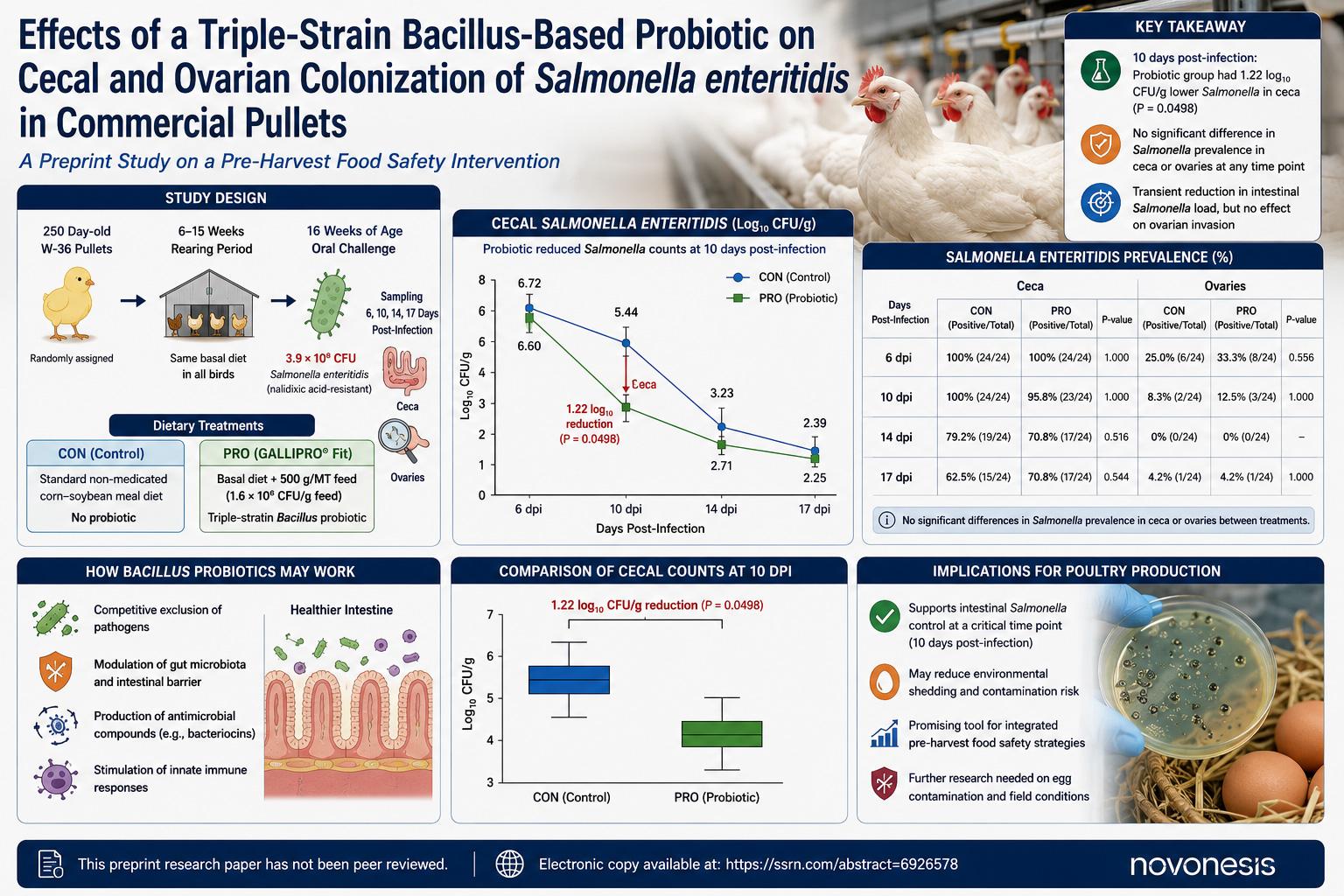
A non-peer-reviewed preprint study evaluates whether a commercial triple-strain Bacillus-based probiotic, GALLIPRO® Fit, can reduce Salmonella enteritidis colonization in commercial layer pullets. The study used 250 day-old W-36 pullets assigned to either a non-supplemented control diet or a probiotic-supplemented diet. At 16 weeks of age, both groups were orally challenged with 3.9 × 10⁸ CFU of a nalidixic acid-resistant Salmonella enteritidis strain, and cecal contents and ovaries were sampled at 6, 10, 14, and 17 days post-infection.
The main finding is specific and limited: probiotic-fed birds had significantly lower cecal Salmonella enteritidis counts at 10 days post-infection, with a 1.22 log₁₀ CFU/g reduction compared with controls. However, this reduction was not observed at 6, 14, or 17 days post-infection. The probiotic also did not significantly reduce Salmonella prevalence in the ceca or ovaries. This means the product may have contributed to a temporary reduction in intestinal Salmonella load during the mid-phase of infection, but the study does not show durable intestinal protection or reduced reproductive-tract invasion under the tested conditions.
This study addresses a food-safety problem with direct relevance to egg production: Salmonella enteritidis can colonize laying hens and create risk for egg contamination before eggs even leave the bird. Unlike contamination that happens after an egg is laid, Salmonella enteritidis can invade internal organs, including the reproductive tract, and contaminate eggs before shell formation. That makes control at the pre-harvest stage especially important.
The paper begins from the public-health importance of Salmonella enterica. It cites Salmonella as a major cause of foodborne illness and notes estimates for the United States of approximately 1.35 million infections, 26,500 hospitalizations, and 420 deaths annually. Among Salmonella serovars, Salmonella enteritidis is especially associated with shell eggs and egg products. For the egg industry, this organism is not only a microbiological concern; it is a regulatory, economic, animal-health, and consumer-trust concern.
The study is positioned within the search for additional pre-harvest control strategies. Current Salmonella control in poultry production includes biosecurity, pest control, environmental monitoring, feed and water hygiene, vaccination, therapeutics where appropriate, and feed additives. In the United States, the FDA Egg Safety Rule requires preventive measures, environmental monitoring, and testing protocols. These interventions reduce risk but do not eliminate Salmonella colonization. Therefore, poultry producers and researchers continue to explore complementary strategies that can lower pathogen load before eggs enter the food chain.
Probiotics are one such strategy. In poultry, a probiotic is a live microbial feed additive intended to benefit the host when administered in adequate amounts. Bacillus-based probiotics are particularly attractive because Bacillus species form spores. Spores can better tolerate feed manufacturing, storage, and passage through the upper gastrointestinal tract compared with many non-spore-forming bacteria. This makes Bacillus products practical for commercial feed systems.
The proposed mechanisms are biologically plausible but complex. Bacillus-based probiotics may compete with pathogens for nutrients and attachment sites, alter the gut microbiota, produce antimicrobial compounds, improve gut barrier function, or modulate immune responses. However, probiotic effects are often variable. The outcome can depend on strain composition, dosage, bird age, diet, challenge strain, pathogen dose, housing conditions, microbiota status, sampling time, and whether the study measures intestinal counts, shedding, organ invasion, egg contamination, or production performance.
The specific objective of this study was to test whether a commercial multi-strain Bacillus-based probiotic could reduce cecal colonization and ovarian invasion of Salmonella enteritidis in commercial layer pullets following experimental challenge. This is a useful design because it separates two related but different outcomes. Cecal colonization reflects intestinal pathogen load. Ovarian invasion reflects systemic spread toward the reproductive tract, which is more directly relevant to internal egg-contamination risk. A feed additive could affect one outcome without affecting the other.
The study used 250 day-old W-36 pullets. The birds were obtained from Hy-Line Hatchery and randomly assigned to two dietary treatment groups. One group received a standard non-medicated corn and soybean meal basal diet without probiotic supplementation. The other group received the same basal diet supplemented with GALLIPRO® Fit at 500 g/MT of feed, corresponding to 1.6 × 10⁶ CFU/g of finished feed. The Bacillus concentration in the probiotic group was verified by culture-based methods.
The experimental housing was controlled. The birds were placed in cage units in separate identical BSL-2 isolation rooms at the AAALAC-accredited Laboratory Animal Resources facility at Iowa State University. Until 8 weeks of age, each treatment group was assigned to a cage unit, and at 8 weeks the pullets were moved into 3-tier cage units to prepare for pre-lay light stimulation. Temperature, humidity, lighting, feeder space, drinking nipples, and diet formulation were managed according to W-36 pullet recommendations. This controlled setting helps reduce environmental variation, but it also means the results may not fully represent commercial barn conditions.
Before challenge, the study screened for Salmonella enteritidis. Chick boxes were swabbed at placement, and manure collection trays were swabbed at 14 weeks of age to confirm negative Salmonella enteritidis status before the experimental infection. This is important because the researchers wanted to measure the effect of a defined challenge strain rather than uncontrolled background Salmonella exposure.
At 16 weeks of age, pullets in both groups were orally challenged with 1 mL of inoculum containing 3.9 × 10⁸ CFU of a nalidixic acid-resistant Salmonella enteritidis strain. The use of nalidixic acid resistance matters methodologically because it allows researchers to selectively recover the challenge strain from samples using media containing nalidixic acid. This reduces confusion between the challenge organism and other background bacteria.
The sampling schedule captured the early and mid-course of infection. At 6, 10, 14, and 17 days post-infection, 24 pullets from each treatment group were euthanized, and cecal pouches and ovaries were collected aseptically. Cecal contents were weighed, diluted, plated on XLT-4 agar containing nalidixic acid, incubated, and counted. The result was expressed as log₁₀ CFU/g. Samples below the detection limit were also cultured to determine presence or absence. Ovaries were enriched in tetrathionate broth with nalidixic acid and then plated to detect Salmonella presence.
The distinction between enumeration and prevalence is central to understanding the paper. Enumeration asks how many Salmonella organisms are present in a positive sample, reported here as log₁₀ CFU/g in cecal contents. Prevalence asks whether a sample is positive or negative. A treatment can reduce bacterial load without changing the number of positive birds. That is exactly what this study suggests at 10 days post-infection: the probiotic reduced cecal counts but did not significantly change prevalence.
The statistical analysis used GraphPad Prism and the nonparametric Kruskal-Wallis test because some datasets did not follow a normal distribution. Differences were considered significant at P < 0.05. Prevalence data were analyzed after digitizing culture results. The choice of nonparametric testing is reasonable for microbiological count data, which can be skewed, but the study’s statistical interpretation is limited by the experimental-unit structure, which the authors acknowledge later.
The main quantitative result appears in Table 1 on pages 7 and 13. At 6 days post-infection, cecal Salmonella enteritidis counts were very high and nearly identical between groups: 6.72 log₁₀ CFU/g in controls and 6.60 log₁₀ CFU/g in probiotic-fed birds, with P = 0.790. This shows that the probiotic did not prevent early intestinal establishment after a large oral challenge.
At 10 days post-infection, the difference became significant. Control birds had 5.44 log₁₀ CFU/g, while probiotic-fed birds had 4.22 log₁₀ CFU/g. The P-value was 0.0498. This corresponds to a 1.22 log₁₀ CFU/g reduction. In practical terms, a 1-log reduction means roughly a tenfold reduction; 1.22 log₁₀ is somewhat more than tenfold. This is the strongest evidence in the paper that the probiotic had a biologically relevant intestinal effect.
However, the effect did not persist clearly at later sampling points. At 14 days post-infection, the control group had 3.23 log₁₀ CFU/g and the probiotic group had 2.71 log₁₀ CFU/g, with P = 0.350. At 17 days post-infection, the control group had 2.39 log₁₀ CFU/g and the probiotic group had 2.25 log₁₀ CFU/g, with P = 0.810. These results suggest that Salmonella levels naturally declined over time in both groups, and the probiotic’s measurable effect was restricted to the mid-phase of infection.
This time-dependent effect is important. It would be misleading to say that the probiotic “prevented Salmonella colonization.” It did not. It would also be too strong to say it “cleared Salmonella.” It did not. The most accurate interpretation is that, under this experimental challenge, the probiotic was associated with a transient reduction in cecal Salmonella load at one sampling time point.
Table 2, also shown on pages 8 and 13, reports prevalence in ceca and ovaries. At 6 days post-infection, cecal prevalence was 24/24 in both groups, meaning 100% of sampled birds were positive. Ovarian prevalence was 6/24, or 25.0%, in controls and 8/24, or 33.3%, in probiotic-fed birds. This does not suggest protection against early ovarian detection.
At 10 days post-infection, cecal prevalence remained almost universal: 24/24, or 100%, in controls and 23/24, or 95.8%, in the probiotic group. Ovarian prevalence was 2/24, or 8.3%, in controls and 3/24, or 12.5%, in probiotic-fed birds. Again, there was no evidence of reduced ovarian invasion.
At 14 days post-infection, cecal prevalence declined in both groups: 19/24, or 79.2%, in controls and 17/24, or 70.8%, in probiotic-fed birds. Ovarian prevalence was 0/24 in both groups. At 17 days post-infection, cecal prevalence was 15/24, or 62.5%, in controls and 17/24, or 70.8%, in probiotic-fed birds. Ovarian prevalence was 1/24, or 4.2%, in both groups. These prevalence data reinforce the central limitation: the probiotic did not significantly reduce the proportion of birds with detectable Salmonella in cecal or ovarian tissue.
The ovarian result is especially important for egg safety. The cecum is a major site of Salmonella colonization and shedding. Reducing cecal load may reduce environmental contamination and horizontal transmission risk. But ovarian invasion is closer to the pathway of internal egg contamination. Because the probiotic did not reduce ovarian prevalence, this study cannot claim that the product reduces reproductive-tract invasion or egg contamination risk directly. The study did not measure actual egg contamination, and the birds were pullets near the onset of lay rather than a full commercial laying-cycle flock.
The authors interpret the 10-day cecal reduction as potentially meaningful despite its transient nature. This is reasonable, because reductions during peak or mid-phase colonization may reduce pathogen shedding into the environment. In a flock, lower shedding could theoretically reduce exposure pressure for other birds. But this study did not measure environmental load over time, bird-to-bird transmission, egg contamination, or commercial flock outcomes. Therefore, the environmental-shedding implication remains biologically plausible but not directly proven by the presented data.
The study’s discussion connects the observed effect to known probiotic mechanisms, including competitive exclusion, microbiota modulation, and antimicrobial compound production. However, the study did not measure gut microbiota composition, intestinal barrier markers, immune responses, short-chain fatty acids, Bacillus recovery, or antimicrobial metabolites. Therefore, the mechanism remains inferred from prior literature rather than demonstrated directly in this experiment. The study shows an outcome at one time point, not the mechanistic pathway that caused it.
A strength of the study is its controlled challenge design. The birds were screened before challenge, the challenge dose was quantified, the strain was marked by nalidixic acid resistance, and multiple post-infection time points were sampled. The use of 24 birds per treatment per time point gives useful microbiological data across the infection period. Measuring both cecal counts and ovarian prevalence also strengthens the practical relevance, because it distinguishes intestinal load from systemic or reproductive invasion.
Another strength is the focus on commercial layer pullets approaching the onset of lay. This is a meaningful biological stage. If Salmonella control can be improved before and around sexual maturity, it may influence risk before egg production begins. However, the study does not continue into egg-laying performance or egg contamination testing, so the connection to actual egg safety outcomes remains indirect.
The limitations are substantial and should be clearly understood. First, the study is a preprint and has not been peer reviewed. Its design, statistical interpretation, and claims have not yet undergone formal external scientific review. Second, the authors state that treatments were applied at the cage level without replication of experimental units. This is a serious design limitation. If each treatment was effectively housed as a single treatment unit, then individual birds may not be fully independent experimental units for treatment-level inference. This can affect how confidently one interprets statistical significance.
Third, the study tested only one probiotic inclusion level: 500 g/MT of feed, corresponding to 1.6 × 10⁶ CFU/g of finished feed. It does not show whether a lower dose, higher dose, different timing, or different administration route would perform better or worse. Fourth, it used a single Salmonella enteritidis challenge strain and a high oral challenge dose of 3.9 × 10⁸ CFU. Commercial exposure may be lower, repeated, intermittent, or involve different strains. The probiotic’s effect under natural exposure could differ from its effect under a high-dose experimental challenge.
Fifth, the trial did not include long-term follow-up beyond 17 days post-infection. It also did not include egg production, egg internal contamination, environmental shedding load, transmission dynamics, microbiome sequencing, immune markers, or performance outcomes. Sixth, the ovarian data were based on detection prevalence rather than quantitative organ load. Because ovarian detection was low and sporadic, the study may have limited power to identify treatment effects on systemic invasion.
Seventh, the authors are affiliated with Novonesis, and the tested probiotic is a branded commercial product. The paper declares no known competing financial interests or personal relationships that could have appeared to influence the work, but readers should still pay attention to funding, affiliation, product involvement, and the need for independent replication. Product-associated research can be scientifically useful, but independent field validation is especially important before broad commercial claims are made.
For poultry producers, the practical interpretation should be cautious and integrated. A Bacillus-based probiotic may contribute to reducing intestinal Salmonella load at certain stages, but it should not be viewed as a stand-alone Salmonella control measure. It does not replace biosecurity, rodent control, sanitation, vaccination programs, environmental monitoring, feed hygiene, water management, FDA-required safety practices, or veterinary oversight. The most defensible role is as a possible component of a broader pre-harvest food-safety program.
For food-safety scientists, the study highlights an important measurement issue: reductions in bacterial counts and reductions in prevalence are not the same. A product may reduce the number of Salmonella organisms in positive birds without making birds culture-negative. This distinction matters for risk assessment. Lower load may reduce shedding and contamination pressure, but persistent prevalence means the pathogen reservoir remains present.
For consumers, the study does not mean that eggs from probiotic-fed hens are automatically Salmonella-free or safer in a guaranteed way. The study did not test eggs, and it did not demonstrate reduced ovarian colonization. Consumer-level food safety still depends on production controls, inspection systems, proper storage, cooking practices, and public-health guidance.
The strongest result in the paper is the statistically significant 1.22 log₁₀ CFU/g reduction in cecal Salmonella enteritidis at 10 days post-infection. The weakest area is the lack of durable or systemic effect: no significant differences were seen at other time points, and no significant cecal or ovarian prevalence reduction was detected. The study’s most honest conclusion is therefore narrow but useful: the tested triple-strain Bacillus probiotic showed a transient reduction in intestinal Salmonella load under controlled challenge conditions, but it did not prevent colonization or reproductive-tract detection.
Future studies should use replicated pen or cage-level experimental units, multiple probiotic doses, different Salmonella strains, longer monitoring periods, commercial field conditions, microbiome and immune profiling, environmental shedding measurements, and egg contamination endpoints. These studies would help determine whether the observed transient reduction can translate into meaningful flock-level food-safety benefits.
Overall, this preprint contributes to the discussion of probiotic-based Salmonella control by providing targeted evidence in pre-lay pullets. It does not solve the Salmonella problem in poultry, and it does not prove reproductive protection. But it does suggest that a multi-strain Bacillus product may temporarily reduce intestinal Salmonella burden at a biologically relevant point after challenge. That is a promising, limited, and testable finding.
Source and Method Note
Source title: Effects of a triple-strain Bacillus-based probiotic on cecal and ovarian colonization of Salmonella enteritidis in commercial pullets.
Authors: S. Corray, M. Schwartz, T. Loeffler, and A. Meuter.
Publication / preprint / report status: This is an SSRN-hosted preprint research paper. The PDF explicitly states that the manuscript has not been peer reviewed.
Peer-review status: Not peer reviewed. The findings should be interpreted as non-peer-reviewed preprint evidence and require cautious reading, independent replication, and peer-review evaluation.
Subject area: Poultry food safety, Salmonella enteritidis control, Bacillus-based probiotics, commercial layer pullets, cecal colonization, ovarian invasion, and pre-harvest pathogen reduction.
Methods used: The study used a controlled experimental challenge design. A total of 250 W-36 pullets were assigned to two dietary treatments: a non-supplemented control diet and a GALLIPRO® Fit probiotic-supplemented diet at 500 g/MT of feed, corresponding to 1.6 × 10⁶ CFU/g of finished feed. At 16 weeks of age, birds were orally challenged with 3.9 × 10⁸ CFU of a nalidixic acid-resistant Salmonella enteritidis strain. Cecal contents and ovaries were collected at 6, 10, 14, and 17 days post-infection.
Dataset and experimental structure: At each sampling point, 24 pullets per treatment group were euthanized for sample collection. Cecal contents were quantitatively plated to enumerate Salmonella enteritidis as log₁₀ CFU/g. Cecal and ovarian prevalence were assessed by culture-based detection. Ovarian tissues were enriched in tetrathionate broth containing nalidixic acid and plated on selective media. Statistical analysis used GraphPad Prism and the nonparametric Kruskal-Wallis test, with significance defined at P < 0.05.
Tables and page numbers: Table 1 on pages 7 and 13 reports Salmonella enteritidis counts in cecal contents. It shows a significant reduction at 10 days post-infection in the probiotic group compared with controls: 4.22 versus 5.44 log₁₀ CFU/g, P = 0.0498, equivalent to a 1.22 log₁₀ CFU/g reduction. No significant differences were observed at 6, 14, or 17 days post-infection. Table 2 on pages 8 and 13 reports prevalence of Salmonella enteritidis in cecal and ovarian tissues and shows no significant treatment-related reduction in cecal or ovarian prevalence at any sampling time.
Formula and statistical explanation: Cecal Salmonella count was calculated using the standard plate-count formula: CFU/g = (number of colonies × dilution factor) / volume cultured. Counts were reported as log₁₀ CFU/g. Prevalence was reported as the number and percentage of culture-positive samples. The key statistical result is the P = 0.0498 difference at 10 days post-infection for cecal counts; all other reported time points and prevalence comparisons were not significant.
Important caution: This article is an explanatory interpretation of a non-peer-reviewed preprint. It is not a food-safety certification, not a poultry-health treatment recommendation, not a veterinary prescription, not a regulatory approval, not a guarantee of Salmonella-free eggs, not a farm-management order, not legal advice, not investment advice, not medical advice, not an engineering certification, not a religious ruling, and not an official policy directive. Poultry producers should interpret probiotic use within integrated Salmonella control programs and with qualified veterinary, regulatory, and food-safety guidance.