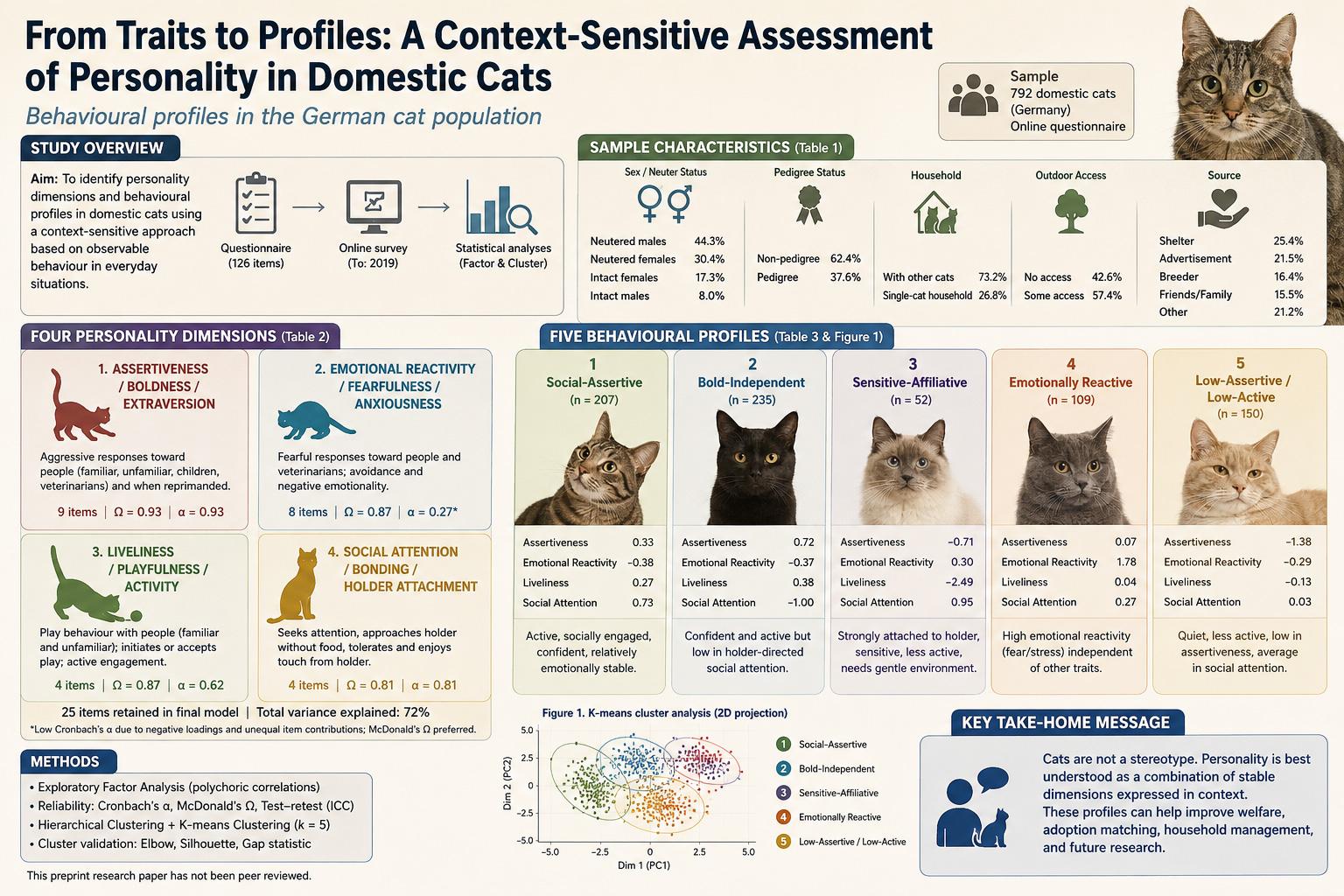
A new non-peer-reviewed preprint study examines domestic cat personality by moving away from broad adjective labels and instead asking cat holders about observable behaviours in everyday contexts. Based on questionnaire data from 792 domestic cats in Germany, the researchers identify four stable personality dimensions: Assertiveness, Emotional Reactivity, Liveliness, and Social Attention. They then use these dimensions to classify cats into five behavioural profiles: Social-Assertive, Bold-Independent, Sensitive-Affiliative, Emotionally Reactive, and Low-Assertive / Low-Active.
The study is important because it challenges the oversimplified idea that cats can be understood through a single stereotype, such as being independent, aloof, or unsocial. Instead, it suggests that feline personality is best understood as a combination of stable traits and context-dependent behavioural expression. This matters for cat welfare, adoption counselling, household management, behavioural support, and potentially animal-assisted intervention settings. However, because the paper is a preprint and has not been peer reviewed, its conclusions should be read as promising but provisional evidence rather than settled scientific consensus.
This study addresses a practical and scientific problem: how can we describe a domestic cat’s personality without forcing the animal into human-centred or dog-centred categories? Many cat owners use everyday labels such as “friendly,” “shy,” “dominant,” “playful,” or “independent.” These labels can be useful in ordinary conversation, but they are not always precise. One owner’s “independent” cat may simply be less physically affectionate. Another owner’s “aggressive” cat may be fearful in specific situations, such as veterinary handling or contact with unfamiliar children. The central argument of this paper is that feline personality should not be assessed only through abstract adjectives. It should also be studied through concrete behaviours expressed in specific contexts.
The authors position their work within a growing research field on domestic cat personality. Earlier studies have already shown that cats differ from one another in stable ways. Models such as the Feline Five have helped establish feline personality as a measurable construct. However, the authors argue that existing tools often rely on general trait ratings, broad behavioural inventories, or problem-oriented measures. These approaches can be useful, but they may not fully capture how a cat behaves differently toward its holder, unfamiliar people, children, veterinarians, or other cats. The study therefore asks a more context-sensitive question: when cat holders report observable behaviours in everyday social situations, what personality dimensions emerge, and can those dimensions form meaningful behavioural profiles?
This distinction is important because cats are not simply small dogs with different body language. The paper explicitly warns against interpreting cats through dog-centred or human-centred expectations. A cat that does not constantly seek contact may not be “cold.” A cat that reacts defensively at the veterinarian may not be globally aggressive. A cat that avoids unfamiliar people may still be deeply bonded to its holder. By building the questionnaire around behavioural contexts, the study tries to reduce the risk of anthropomorphic projection and owner interpretation bias. In simple terms, the researchers are not only asking “Is this cat anxious?” They are asking, “In which situations does this cat show fear, avoidance, approach, play, touch tolerance, or aggression?”
The study’s first major contribution is the development of a questionnaire called Cat Q. The questionnaire was originally developed in English by the first and second authors, then translated into German and Italian, with additional Hungarian and Turkish versions prepared within the research consortium. The present paper analyzes the German version. This multilingual development is relevant because animal behaviour questionnaires can be sensitive to wording. A behaviour that is clear in one language may carry slightly different connotations in another. The authors used back-translation and internal review to improve semantic equivalence, and 15 native speakers reviewed the German version for clarity.
The questionnaire contained 126 items divided into four subscales: 14 socio-demographic items, 56 personality-related behaviour items, 14 habit items, and 42 items concerning interactions with humans and conspecifics. Behavioural items used a five-point Likert scale from 0 (“never”) to 4 (“always”). This means the study did not simply ask owners whether a cat “is social” or “is fearful.” It asked how often specific behaviours occurred in defined situations. For example, some retained items asked whether the cat was aggressive toward familiar people, unfamiliar people, children, or veterinarians, or whether it allowed touch when the holder approached.
The sample consisted of 792 domestic cats whose holders completed the baseline questionnaire. Participants had to be at least 18 years old and own at least one cat that had lived in the household for more than three months. If a respondent owned multiple cats, they were asked to answer for the cat with whom they had the longest-established bond. This rule matters because it likely increased the holder’s familiarity with the animal, but it may also have introduced a bias toward cats with stronger human-cat relationships. Cats of any health status were eligible, and the questionnaire collected information about medication and medical conditions.
The sample was heterogeneous but not perfectly representative of all cats. Table 1, appearing on pages 27-28, shows the socio-demographic distribution. Neutered males formed the largest sex category, with 351 cats, representing 44.3% of the sample. Neutered females accounted for 241 cats, or 30.4%. Intact females represented 137 cats, or 17.3%, and intact males 63 cats, or 8.0%. Most cats were non-pedigree: 494 cats, or 62.4%, compared with 298 pedigree cats, or 37.6%. A large majority, 580 cats or 73.2%, lived with other cats, while 212 cats or 26.8% did not. This is highly relevant because social context may influence how personality is expressed. A cat living with other cats may show behaviours that a single cat has fewer opportunities to express.
Housing conditions were also diverse. In Table 1, 337 cats, or 42.6%, had no outdoor access. Others had different forms of outdoor access, including free access, enclosed garden access, leash-only access, supervised access, or outdoor living. The paper summarizes that 57.4% of cats had some form of outdoor access. This matters because environmental exploration, confidence, activity, and stress behaviour may look different in indoor-only cats compared with cats that experience more varied outdoor environments. The sample also included cats acquired from shelters, advertisements, breeders, friends or family, rehoming situations, and stray/found origins. The most common source was shelter adoption, with 201 cats or 25.4%, followed by advertisements at 170 cats or 21.5%, and breeders at 130 cats or 16.4%.
The data collection procedure was fully online. The baseline survey, called T0, was collected from January to October 2019. Follow-up surveys were conducted in April 2022 and June 2022 to assess test-retest reliability. Participants created anonymous identification codes so that responses could be matched across time without collecting personal identity data. The authors state that, under German regulations and GDPR, this anonymous voluntary questionnaire study did not require formal ethical approval. This does not mean ethics were ignored; rather, the study design was considered outside the category requiring formal review because no personal data were collected and the information referred only to animals.
The statistical design has two main layers. First, the authors used exploratory factor analysis to identify underlying personality dimensions. Second, they used cluster analysis to see whether combinations of those dimensions formed recognizable behavioural profiles. These are different but complementary questions. Factor analysis asks: “Which behavioural items tend to move together and therefore may represent a shared latent trait?” Cluster analysis asks: “When cats are scored on those traits, do groups of cats show similar overall patterns?” This distinction is central to the paper’s value. It does not only produce traits; it also proposes personality profiles that may be easier to apply in real-world settings such as shelters, homes, and behavioural counselling.
For the exploratory factor analysis, the authors began with 112 behavioural items from three questionnaire subscales: personality-related behaviour, habits, and interaction with humans and conspecifics. Because the item responses were ordinal and skewed, they used polychoric correlation matrices. This is appropriate when responses are ordered categories rather than continuous measurements. The Kaiser-Meyer-Olkin value was 0.778, which the authors interpret as indicating sufficient common variance among variables. Bartlett’s test of sphericity was significant, supporting the suitability of the data for factor analysis.
The paper discusses how the number of factors was selected. Parallel analysis suggested 13 factors, while the scree plot and Velicer’s Minimum Average Partial test supported a four-factor solution. The authors retained four factors, arguing that parallel analysis may overextract trivial factors in large samples. This is an important methodological choice. A 13-factor solution might capture many small patterns, but it could be harder to interpret, less stable, and less useful. A four-factor model is more parsimonious, but it may also leave out some nuanced behaviours. The authors therefore make a trade-off: they prefer a clearer and more stable structure over a more fragmented model.
The final exploratory factor analysis retained 25 items and produced four stable dimensions explaining 72% of the variance in the retained item set. The four dimensions were Assertiveness / Boldness / Extraversion, Emotional Reactivity / Fearfulness / Anxiousness, Liveliness / Playfulness / Activity, and Social Attention / Bonding / Holder Attachment. These names are not casual labels; they reflect the item content that loaded on each factor. For example, the first factor was not called “dominance” in a broad abstract sense. It was built from items describing aggressive responses across different social partners and reprimand contexts.
Table 2, shown across pages 28-29, is one of the most important parts of the paper because it reveals what each factor actually means. Factor 1 includes nine aggression-related items, such as aggression toward familiar persons, unknown persons, children, and veterinarians, as well as aggression when reprimanded by different partners. Loadings ranged from 0.60 to 0.90, with McDonald’s omega and Cronbach’s alpha both equal to 0.93. These are high reliability values. The interpretation is that aggressive or assertive responses across social contexts formed a coherent latent dimension. However, this should not be misread as saying “assertive cats are bad cats.” The factor describes a behavioural tendency, not a moral judgement. In welfare terms, it may indicate cats that need careful handling, predictable routines, and respect for boundaries.
Factor 2 captures Emotional Reactivity / Fearfulness / Anxiousness. It includes fearful responses toward familiar persons, unknown persons, children, and veterinarians, along with approach or attention-related items toward unfamiliar people that loaded negatively. Factor loadings ranged from -0.60 to 0.93. The reliability pattern is technically important: McDonald’s omega was 0.87, but Cronbach’s alpha was only 0.27. At first glance, that low alpha could look like a weakness. The authors explain that alpha is low because the items have unequal loadings and include both positive and negative loadings, violating assumptions that Cronbach’s alpha depends on. They therefore treat omega as the more suitable reliability estimate. This is a good example of why a reader should not interpret a single statistic mechanically. The factor may still reflect a meaningful latent construct even when alpha is low.
Factor 3 represents Liveliness / Playfulness / Activity. It includes items about playing with the holder, familiar persons, and unfamiliar persons, as well as initiating or accepting play. Loadings ranged from -0.57 to 0.91, and reliability was acceptable to strong, with omega 0.87 and alpha 0.62. This factor does not simply mean “young cats play more.” Age may influence play, but the model treats playfulness as a behavioural dimension observed across interaction partners. Future research would need to model age directly to understand how much of this factor reflects personality, life stage, health, or environment.
Factor 4 is Social Attention / Bonding / Holder Attachment. It includes attention-seeking, approach behaviour without food, and tolerance of touch, especially in relation to the holder. Loadings ranged from 0.57 to 0.89, with omega and alpha both 0.81. This factor is especially useful because it separates social attention from general activity or aggression. A cat can be playful without being highly holder-attached. Another cat can be quiet but strongly bonded. This distinction matters in adoption and household expectations: a person seeking a very interactive companion may not only need a playful cat, but one that shows high holder-directed social attention.
The study also reports many excluded items. This is not a minor detail. Items were removed when they had low communalities, weak primary loadings, or substantial cross-loadings. Excluded domains included highly situational behaviours such as reactions to moving house, rare behaviours such as prey-related actions, some cat-cat interactions, habitual behaviours, feeding patterns, object destruction, and behaviours difficult for holders to observe consistently. This tells us something scientifically important: not every meaningful behaviour becomes a stable questionnaire factor. Some behaviours may be too rare, too context-dependent, too environmentally shaped, or too hard for owners to report reliably. The absence of a stable factor is therefore not always a failure; sometimes it is evidence that a behaviour does not operate like a broad personality trait in this measurement design.
The second major analytical step is cluster analysis. After calculating factor scores for the four dimensions, the authors standardized the variables and used hierarchical clustering to explore grouping structure. They then used cluster validity indices, including the elbow method, silhouette analysis, and the gap statistic, which all supported a five-cluster solution. Three outliers were excluded before the final k-means analysis. This procedure matters because k-means requires the researcher to specify the number of clusters, so the authors used hierarchical results and validity indices to justify k = 5 rather than choosing it arbitrarily.
Table 3, on page 30, reports the five clusters using standardized mean factor scores. These numbers are central to understanding the profiles. Cluster 1, with 207 cats, had moderately elevated Assertiveness at 0.33, lower Emotional Reactivity at -0.38, elevated Liveliness at 0.27, and high Social Attention at 0.73. The authors call this profile Social-Assertive. In everyday language, these cats appear active, socially engaged with their holder, and relatively emotionally stable, while also showing some assertive tendencies. This profile may be practically valuable because such cats are neither passive nor highly fearful, and they show strong human-directed affiliation.
Cluster 2 was the largest group, with 235 cats. It showed high Assertiveness at 0.72, low Emotional Reactivity at -0.37, elevated Liveliness at 0.38, and very low Social Attention at -1.00. The authors call this profile Bold-Independent. This group resembles the public stereotype of cats as independent and less socially attached. However, the study’s broader result is that this is only one profile among five, not the definition of cat nature. These cats may be active and confident but less motivated to seek holder-directed contact. In a home, this could be a good match for people who respect autonomy and do not expect constant physical affection. It might be a poor match for someone who wants frequent cuddling and close interaction.
Cluster 3, with 52 cats, is labelled Sensitive-Affiliative. It had low Assertiveness at -0.71, increased Emotional Reactivity at 0.30, very low Liveliness at -2.49, and the highest Social Attention at 0.95. This is a particularly interesting profile because it combines strong attachment or social attention with low activity and greater sensitivity. These cats may seek closeness but also be vulnerable to stress or overstimulation. In practical terms, such animals may benefit from calm environments, predictable routines, gentle handling, and low-pressure social interaction. The profile should not be reduced to “needy” or “weak”; it may reflect cats that form strong bonds but need careful welfare-sensitive management.
Cluster 4 included 109 cats and was defined mainly by very high Emotional Reactivity at 1.78. Its other scores were close to average: Assertiveness 0.07, Liveliness 0.04, and Social Attention 0.27. The authors call this group Emotionally Reactive. This profile is important because it shows that fearfulness or emotional sensitivity can stand out independently of activity, assertiveness, or bonding. In daily life, these cats may not necessarily be inactive or unsocial, but they may respond strongly to stressors such as unfamiliar people, children, veterinary visits, or sudden changes. For welfare, this points toward the importance of environmental control, gradual introductions, stress reduction, and sensitive veterinary handling.
Cluster 5, with 150 cats, is labelled Low-Assertive / Low-Active. It had strongly reduced Assertiveness at -1.38, slightly below-average Emotional Reactivity at -0.29, slightly below-average Liveliness at -0.13, and near-average Social Attention at 0.03. These cats may be less forceful, less active, and not especially extreme in fear or affiliation. In adoption or household contexts, this profile might suit quieter homes, but it should not automatically be interpreted as poor welfare or low interest. Low assertiveness may mean the cat is less likely to use overt aggression, but it could also mean distress is expressed subtly. Owners and shelters should therefore avoid assuming that a quiet cat has no needs.
Figure 1, on page 30, visualizes the k-means cluster analysis. The figure shows a two-dimensional projection onto the first two principal components, even though the clusters were estimated in the original four-dimensional factor space. This distinction matters. The plot is a visualization, not the full mathematical clustering space. A reader should not judge the entire quality of the cluster solution only from the two-dimensional figure. Its purpose is to make the five groups visible in a simplified form. The actual clustering used the four standardized factor scores: Assertiveness, Emotional Reactivity, Liveliness, and Social Attention.
The study’s strongest conceptual point is that feline personality is not a single line from “friendly” to “unfriendly” or from “bold” to “fearful.” Instead, cats can combine traits in different ways. A cat can be socially attentive and sensitive. Another can be bold and independent. Another can be emotionally reactive without being unusually aggressive or inactive. This profile-based interpretation is useful because real-life decisions are often about combinations. For example, a shelter does not only need to know whether a cat is playful. It needs to know whether the cat is playful and socially attentive, playful but low in bonding, or sensitive but highly affiliative.
This has immediate relevance for adoption counselling. Many unsuccessful human-cat relationships may come from mismatched expectations rather than “bad” cats or “bad” owners. A person wanting a lap cat may become disappointed with a Bold-Independent cat. A busy household with children and frequent visitors may overwhelm an Emotionally Reactive cat. A calm adult household may be ideal for a Sensitive-Affiliative cat if the humans understand the cat’s need for gentleness and stability. By translating trait scores into profiles, the research may help shelters and owners make more welfare-oriented matches.
The findings also have implications for animal-assisted interventions, although the authors are careful to treat this as speculative. Cats used in therapeutic or educational settings need behavioural stability, sociability, tolerance, and welfare protection. The authors suggest that Cluster 1 may align most closely with characteristics generally desirable for intervention settings because it combines social attention, activity, and lower emotional reactivity. Cluster 3 may be suitable only in structured, low-demand environments with careful monitoring. Clusters 2, 4, and 5 may present different limitations, such as reduced social attention, heightened emotional reactivity, or very low assertiveness. These are not clinical selection rules; they are hypotheses for future research.
The paper also adds nuance to the discussion of impulsiveness and environmental exploration. Unlike some earlier personality models, this study did not find a stable factor for Impulsiveness or Environmental Exploration, even though such behaviours were assessed. Rather than treating this as a simple failure, the authors interpret it as meaningful. When owners report concrete behaviours in specific contexts, impulsive or exploration-related behaviours may be too dependent on housing, environment, management, age, or opportunity to form a stable latent trait. For example, an indoor cat and an outdoor-access cat may have very different chances to display exploration. A cat may appear less exploratory not because of personality, but because of limited environmental opportunity.
This point is valuable for everyday interpretation. Owners often say a cat is “curious” or “not curious,” but curiosity may be shaped by the physical environment, safety, early experience, health, stress, and available stimulation. The study reminds us that behaviour is not only personality. It is personality expressed through context. This is one of the most important messages for non-specialist readers: a cat’s behaviour should not be judged without asking what situations the cat has actually experienced.
The paper’s methodological strengths include its relatively large sample size, behaviourally anchored item design, use of ordinal-data-appropriate polychoric correlations, multiple approaches to deciding factor number, reliability testing, and combination of factor analysis with cluster analysis. The multilingual development of the questionnaire also creates a foundation for future cross-cultural studies. Another strength is the authors’ cautious interpretation of excluded items and context dependence. They do not pretend that the questionnaire captures every possible aspect of cat personality.
However, the limitations are substantial and should be clearly understood. First, the data come from voluntary holder reports. Owners who join cat-related social media groups and complete detailed questionnaires may not represent all cat holders. They may be more interested in cat behaviour, more attached to their animals, or more likely to observe certain behaviours. Second, owner reports can be biased. A holder may misinterpret fear as stubbornness, playfulness as attention-seeking, or avoidance as independence. The behaviourally specific questionnaire helps reduce this problem, but it cannot eliminate it.
Third, the sample may underrepresent some cat populations, especially free-ranging cats, feral cats, cats with limited human contact, and cats in very different cultural or housing environments. The study is focused on the German cat-holder population and therefore should not automatically be generalized to all domestic cats worldwide. Fourth, although breed and age were recorded, the sample was not balanced enough to model robust breed-specific effects, and age was not treated as a central predictor. This is important because breed, development, aging, health, and early socialization may all influence behaviour.
Fifth, the questionnaire’s final structure retained only 25 behavioural items from a much larger item pool. This improves clarity and statistical stability, but it also narrows the instrument. Some theoretically important behaviours, including cat-cat interactions, environmental exploration, prey-related behaviours, and certain habits, did not survive item reduction. This means the final model is not a complete map of cat behaviour. It is a psychometrically clearer model of the behaviours that formed stable dimensions in this dataset.
Sixth, the study is a preprint and has not been peer reviewed. This is not a reason to dismiss it, but it does affect the evidence level. Peer review may identify methodological issues, request additional analyses, challenge interpretations, or improve reporting. The findings should therefore be treated as a serious and potentially useful contribution, but not as final settled evidence. Future independent replication, behavioural observation, longitudinal tracking, and cross-cultural validation are needed before the questionnaire and profiles can be used with high confidence in applied settings.
The practical value of the study lies in changing how people think about cats. Instead of asking whether cats are “social” or “independent” as a species, it encourages us to ask what kind of social attention, emotional reactivity, liveliness, and assertiveness a particular cat shows in particular contexts. This can improve everyday care. A highly emotionally reactive cat may need slower introductions, hiding places, predictable routines, and gentle veterinary preparation. A highly lively cat may need more play structure and enrichment. A socially attentive cat may need regular interaction. A low-assertive cat may need careful observation because it may not loudly protest discomfort.
For shelters, the study suggests that personality profiles could eventually support more accurate placement decisions. Rather than describing a cat with one vague adjective, staff could build a profile: how active is the cat, how socially attentive, how emotionally reactive, and how assertive? This may reduce mismatches and improve long-term welfare. For veterinarians and behaviour consultants, the framework could help distinguish fear-based reactions from assertive responses or low activity from low social bonding. For researchers, the study offers a model that integrates dimensional traits with profile-based interpretation.
The past, present, and future relevance of this work are connected. Historically, cat personality research has moved from broad observation and owner impressions toward more structured measurement. In the present, many homes, shelters, and welfare organizations need better tools for understanding individual cats, especially as expectations for companion animal welfare become more sophisticated. In the future, context-sensitive personality assessment could be combined with behavioural observation, wearable activity data, veterinary stress indicators, genetic information, and longitudinal follow-up. That would allow researchers to ask deeper questions: Which profiles are stable across life? Which environments support each profile best? Which cats are most vulnerable to stress? Which human-cat matches produce the best welfare outcomes?
The central meaning of the study is therefore not that every cat must be placed into one rigid category. The more careful interpretation is that cats show stable but context-sensitive behavioural tendencies, and those tendencies can combine into meaningful profiles. A profile should be a guide for observation, not a label that limits the animal. Used responsibly, this approach can help humans understand cats more accurately, respect their individuality, and make better decisions for their welfare.
Source and Method Note
Source title: From Traits to Profiles: A Context-Sensitive Assessment of Personality in Domestic Cats. The manuscript also carries the subtitle “Behavioural profiles in the German cat population.”
Authors: Isabelle Kappel, Stefania Uccheddu, Christoph Gross, and Udo Ganslosser.
Publication / preprint / report status: This is an SSRN-hosted preprint research paper. The PDF explicitly states that the preprint research paper has not been peer reviewed and includes the notice “Preprint not peer reviewed.” It should therefore be treated as non-peer-reviewed preprint evidence.
Peer-review status: Not peer reviewed. The findings should be interpreted cautiously until independent peer review, replication, and additional validation are available.
Subject area: Domestic cat personality, feline behavioural assessment, companion animal welfare, psychometrics, human-cat interaction, and applied animal behaviour science.
Methods used: The study developed a context-sensitive questionnaire for domestic cats, administered it online to German cat holders, and analyzed responses using psychometric and multivariate methods. The main statistical methods included exploratory factor analysis based on polychoric correlation matrices, reliability analyses using Cronbach’s alpha and McDonald’s omega, test-retest reliability using intraclass correlation coefficients, hierarchical cluster analysis, and k-means clustering.
Dataset and sample structure: The baseline dataset included 792 domestic cats. The sample included neutered and intact males and females, pedigree and non-pedigree cats, indoor-only cats and cats with various forms of outdoor access, single-cat and multi-cat households, and cats from shelters, breeders, advertisements, friends or family, rehoming, and stray/found origins. Follow-up surveys were conducted in 2022 to assess temporal stability.
Questionnaire design: The questionnaire contained 126 items across socio-demographic information, personality-related behaviour, habits, and interaction with humans and conspecifics. Behavioural items were rated on a five-point Likert scale from 0 (“never”) to 4 (“always”). The instrument was developed in English, translated into German and Italian, and additional Hungarian and Turkish versions were prepared. The present paper analyzes the German version.
Figures, tables, and page numbers: Table 1 on pages 27-28 reports the socio-demographic sample distribution, including sex/neuter status, age groups, pedigree status, outdoor access, multi-cat household status, medication requirement, and source of the cat. Table 2 on pages 28-29 presents the factor pattern matrix, item loadings, communalities, eigenvalues, cumulative variance, and reliability indices for the four retained personality dimensions. Table 3 on page 30 reports standardized factor-score means and standard deviations for the five behavioural clusters. Figure 1 on page 30 visualizes the k-means cluster analysis as a two-dimensional projection of clusters estimated from the four-dimensional factor-score space.
Formula and statistical explanation: The paper does not rely on a central biological or mathematical formula for its argument. Its quantitative structure is based on psychometric statistics and clustering methods. Factor loadings indicate how strongly questionnaire items relate to latent personality dimensions. Reliability indices such as McDonald’s omega and Cronbach’s alpha estimate how coherently items measure a construct. Cluster analysis groups cats according to their standardized scores across the four personality dimensions.
Important caution: This article is an explanatory scientific interpretation of a non-peer-reviewed preprint. It is not veterinary medical advice, not a diagnosis, not a clinical treatment recommendation, not an animal welfare certification, not an official policy order, not legal advice, not an investment recommendation, not an engineering certification, not a safety approval, and not a religious ruling. Cat owners, shelters, veterinarians, and behaviour professionals should use the findings as a research-informed perspective, not as a substitute for direct behavioural assessment or professional veterinary and welfare guidance.