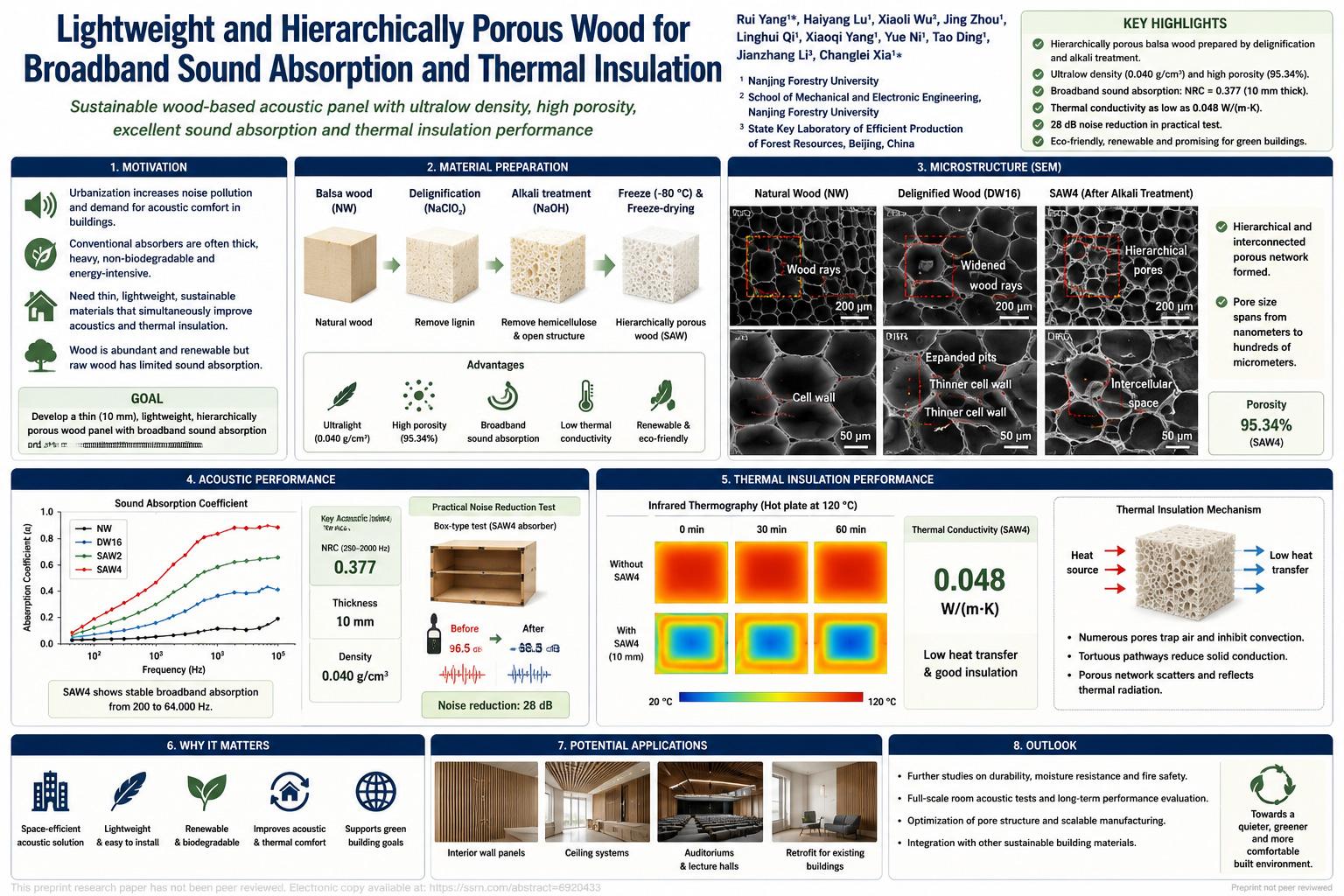
This study addresses a problem that is becoming increasingly important in modern buildings: how to control noise and improve thermal comfort without relying on thick, heavy, synthetic, energy-intensive, or environmentally problematic materials. As urbanization increases, people are exposed to more traffic noise, dense residential environments, mechanical systems, and indoor acoustic disturbance. At the same time, green buildings must reduce energy use, improve comfort, and avoid materials that create secondary environmental burdens. The study therefore asks whether natural wood, especially balsa wood, can be transformed into a thin, lightweight, sound-absorbing and thermally insulating panel.
The central material challenge is a trade-off. Conventional porous sound absorbers can perform well, but they often require considerable thickness to work effectively, especially at lower frequencies. Many inorganic fibers, polymer foams, and synthetic porous materials can absorb sound, but they may be energy-intensive to produce, difficult to biodegrade, or environmentally undesirable. For building retrofits, thickness is especially important. A material may work acoustically in the laboratory, but if it requires too much wall depth, weight, or installation complexity, it may not be practical for existing buildings.
The paper positions wood as a promising alternative because wood is naturally porous, renewable, structurally hierarchical, and familiar in architecture. However, untreated natural wood is not automatically a good sound absorber. Solid wood may reflect a large portion of incident sound energy because its native pore structure is not sufficiently open, interconnected, or optimized for sound-wave dissipation. The authors therefore focus on modifying the internal structure of balsa wood so that sound waves can enter, scatter, and lose energy inside the material.
Balsa wood is a logical choice for this work. It has a short growth cycle, low density, high porosity, and good processability. Its natural cellular structure already contains lumens, cell walls, pits, intercellular spaces, and wood rays. These features provide a useful starting architecture. The research idea is not to invent a completely artificial acoustic foam, but to use the wood’s existing biological structure and open it further through chemical pretreatment.
The study’s novelty lies in creating a hierarchical porous wood absorber that remains thin, lightweight, and structurally continuous. The authors emphasize that their material is only about 10 mm thick, roughly half the thickness often associated with traditional sound-absorbing building materials such as glass fiber panels of about 20 mm or greater. This matters because a 10 mm panel can be more realistic for retrofit applications, interior wall surfaces, acoustic decoration, and space-constrained green buildings.
The experimental procedure begins with balsa wood samples cut into two sizes: 29 mm diameter × 10 mm thickness and 100 mm diameter × 10 mm thickness, with thickness along the transverse direction. The samples are then chemically treated in two major steps. First, they are treated with 2 wt.% sodium chlorite solution adjusted to pH 6 with acetic acid at 105 °C. This delignification step lasts 12, 16, 20, or 24 hours, with solution replacement every 4 hours. Second, some samples are treated in 4 wt.% sodium hydroxide solution at 100 °C for 2, 4, 6, or 8 hours. Finally, the samples are frozen at −80 °C and freeze-dried for 72 hours.
The labeling system is important. Untreated natural wood is called NW. Delignified wood is labeled DW, followed by the delignification time, such as DW16 for 16 hours of delignification. Samples that undergo additional alkali treatment are called SAW, followed by alkali treatment time, such as SAW4 for 4 hours of alkali treatment. The most important optimized material discussed throughout the study is SAW4.
Figure 1 on page 10 provides the first overview of the study’s material concept. Figure 1(a) schematically shows how the wood-based sound absorber could be used in a building to reduce noise and provide thermal insulation. Figure 1(b) shows the preparation route: natural wood is transformed through delignification and alkali treatment into a wood-based sound absorber with hierarchical pores and a rough surface. Figure 1(c) compares acoustic and thermal performance, emphasizing that the material is thin, lightweight, and multifunctional. The figure is a conceptual and summary graphic rather than raw experimental evidence, but it clearly communicates the intended building application.
The microstructural transformation is one of the most important parts of the study. Natural wood has a relatively ordered cellular architecture. The cell morphology is regular, cell walls are intact, pits are uniform, and wood rays are arranged in an organized way. This structure gives wood mechanical and biological function, but it is not sufficiently open for high acoustic dissipation. After delignification, the wood rays widen, cell walls become thinner, cell lumens enlarge, some pits expand, and the cellular arrangement becomes more disordered. This loosening allows sound waves to penetrate more deeply.
After alkaline treatment, the structural change becomes stronger. Sodium hydroxide causes alkali swelling and structural reorganization of cellulose. The cellular framework evolves into an interconnected porous network with pores of different sizes. This is the key physical transformation. A sound absorber needs accessible pathways. If pores are too closed, sound reflects. If pores are interconnected and tortuous, sound waves can enter the material and lose energy through friction, heat exchange, and scattering.
Figure 2 on page 11 gives direct visual and pore-structure evidence. Figure 2(a) shows SEM images comparing natural wood and SAW4. The images show wood rays, cell walls, pit expansion, separation, and intercellular spaces. These images support the claim that treatment opens and roughens the wood structure. Figure 2(b) shows adsorption-desorption isotherms for NW, DW, and SAW samples. Natural wood has nearly overlapping adsorption and desorption curves, suggesting a compact and less hysteretic pore system. Treated samples show pronounced hysteresis loops, indicating broader mesoporous structures and more complex pore geometry. Figure 2(c) shows pore size distributions, demonstrating that treated samples shift toward larger and broader pore-size ranges.
The numerical pore result is especially important: the maximum porosity reaches 95.34% for SAW4. This value helps explain why the material becomes ultralight and acoustically active. A material with this level of porosity contains a very large internal air volume and extensive pore-wall surface area. When sound enters such a structure, the air inside the pores moves against the pore walls, creating viscous friction and dissipating acoustic energy.
The authors also report that the pore size range of natural wood spans from 60 nm to 800 μm, reflecting both intrinsic cellular voids and intercellular spaces. After treatment, the pore size distribution shifts to larger diameters and becomes broader. This is important because sound absorption across a broad frequency range benefits from multiscale pore systems. Small pores interact more effectively with higher-frequency sound, while larger pores and cavity-like structures may contribute to lower-frequency interaction. A single pore size would tend to work over a narrower frequency band, but a hierarchical distribution can support broader absorption.
The chemical evidence is presented in Figure 3 on page 14. Figure 3(a) shows XPS spectra for NW, DW16, DW20, and SAW4. The spectra show C 1s and O 1s peaks, indicating that the treatments do not introduce new elemental components into the material. This is relevant for environmental interpretation because the process modifies the wood chemistry mainly by removing components rather than adding foreign functional elements.
Figure 3(b) shows XRD patterns. The cellulose I crystal structure remains present after treatment, meaning the fundamental cellulose crystalline form is preserved. The relative crystallinity increases from NW to DW and SAW, which the authors attribute to progressive removal of non-crystalline components. In practical terms, lignin and hemicellulose are removed, leaving a higher proportion of cellulose structure.
Figure 3(c) shows FTIR spectra. After delignification, the weakening of peaks at 1593, 1503, and 1642 cm⁻¹ indicates lignin removal. After alkali treatment, the disappearance of peaks at 1734 and 1238 cm⁻¹ indicates hemicellulose dissolution. These spectral changes support the chemical mechanism: sodium chlorite removes lignin, and sodium hydroxide removes hemicellulose and part of the residual lignin.
Figure 3(d) shows C1s spectra, where changes in C-C, C-O, and O-C-O bonding further support the removal of lignin and hemicellulose. Figure 3(e) provides a chemical schematic. Under acidic conditions, sodium chlorite generates chlorine dioxide, which oxidizes lignin into smaller water-soluble fragments. In alkaline solution, sodium hydroxide removes hemicellulose through saponification and peeling reactions, while also affecting residual lignin. This figure is useful because it links chemical treatment to structural porosity: removing lignin and hemicellulose creates space inside the wood cell-wall network.
The acoustic testing is performed using a Brüel & Kjær impedance tube system and the transfer function method. Two tube diameters, 29 mm and 100 mm, are used, which helps cover different frequency ranges. The paper calculates the sound absorption coefficient from the reflection factor, where the absorption coefficient equals one minus the squared magnitude of reflected sound. In simple terms, if less sound is reflected back, more sound has been absorbed or dissipated inside the material.
The study also calculates the noise reduction coefficient, NRC, using the average absorption coefficients at 250, 500, 1000, and 2000 Hz. NRC is a simplified single-number indicator of absorption performance. It does not describe the full frequency spectrum, but it is useful for comparing materials in architectural contexts.
Equations 2–5 explain the impedance tube calculation method. Equation 2 defines the transfer function between two microphone positions. Equation 3 defines the reflection factor. Equation 4 calculates the sound absorption coefficient. Equation 5 calculates NRC from four standard frequencies. These formulas matter because they show that the acoustic performance is not based only on subjective listening; it is measured through a standard acoustic method.
Figure 4 on page 16 is the central acoustic performance figure. Figure 4(a) shows absorption coefficient curves for delignified wood samples. Natural wood shows extremely low sound absorption across the frequency spectrum. Delignification improves absorption, but extending delignification time alone does not continuously improve performance. This means simply removing more lignin is not enough. The pore network must be optimized rather than only enlarged.
Figure 4(b) shows absorption coefficient curves for SAW samples after alkali treatment, along with simulation results. The alkali-treated samples show further improvement, especially at higher frequencies, with some improvement at lower frequencies. This supports the idea that the two-step treatment produces a more effective hierarchical pore structure than delignification alone.
The reported best material achieves NRC = 0.377 at a thickness of only 10 mm. This value should be interpreted carefully. An NRC of 0.377 is not the highest possible acoustic absorption value in absolute terms, but it is notable because the material is extremely thin, lightweight, wood-based, and also thermally insulating. The study’s argument is not simply that the material beats all acoustic absorbers. It is that it offers a useful balance of thinness, low density, renewability, acoustic absorption, and thermal insulation.
Figure 4(c) compares NRC and density between conventional acoustic materials, DW20, and SAW4. Figure 4(f) compares NRC and thickness. These comparisons show that DW20 and SAW4 maintain competitive NRC values while having much lower thickness and density than many comparison materials. The key engineering advantage is not only absorption, but absorption per thickness and weight.
The paper reports an ultralow density of 0.040 g/cm³. This is significant for green building retrofits because lightweight panels are easier to install, transport, and integrate into existing structures. Weight also matters for walls, ceilings, partitions, acoustic panels, and applications where the substrate cannot carry heavy additional loads.
Figure 4(g) explains the sound absorption mechanism. The figure describes incident sound waves entering the porous wood structure. Inside the material, sound energy is dissipated through three main mechanisms: viscous attenuation, thermal conduction attenuation, and acoustic scattering. Viscous attenuation occurs when moving air rubs against pore walls and air molecules interact with each other inside narrow pores. Thermal conduction attenuation occurs because sound waves compress and expand air, causing small temperature differences and heat exchange. Acoustic scattering occurs when sound waves undergo multiple reflections and changes of direction within the complex pore network.
The mechanism is important because the material is not working as a single simple absorber. Its hierarchical structure creates multiple pathways. Pits on cell walls, pores formed after chemical treatment, intercellular spaces, cell lumens, wood ray regions, and surface microcracks all help sound enter and propagate through the material. The layered structure and repeated wood-ray arrangement further increase tortuosity and scattering. This combination explains why the material can work across a broad frequency range.
The authors use COMSOL simulations based on the Johnson-Champoux-Allard, or JCA, model to investigate acoustic attenuation. The JCA model predicts sound behavior in porous materials using structural parameters such as porosity, flow resistivity, tortuosity, viscous characteristic length, and thermal characteristic length. This is appropriate because sound absorption in porous materials depends strongly on air movement through tortuous pores. The simulation qualitatively agrees with experimental trends for SAW4, suggesting that viscous and thermal dissipation plus structural complexity govern the material’s acoustic response.
Figure 4(d) shows the simulation model at 1800 Hz. It includes a perfectly matched layer, an airspace, and the wood-based porous sound-absorbing material. The sound pressure and sound pressure level distributions show that sound pressure decays strongly inside the porous layer, while reflected pressure is reduced. Figure 4(e) shows the real part of acoustic pressure inside SAW4 at 1800 Hz. The alternating red-blue pattern indicates interference between incident and internal reflected waves, while decreasing amplitude with depth indicates effective attenuation.
The paper also introduces a Helmholtz-resonator-like analogy in Equation 6. The authors explain that pores formed by individual or combined cell lumens can be qualitatively understood as local resonant units. Larger pores tend to interact with lower frequencies, while smaller pores interact with higher frequencies. However, the paper is careful: this is only a qualitative analogy. SAW4 is not a set of ideal isolated Helmholtz resonators. It is a highly interconnected multiscale porous network. Therefore, the broadband absorption arises from combined local resonances, viscous losses, thermal losses, and multiple scattering, not a single resonance mechanism.
Figure 4(h) shows a practical box-type sound reduction scenario for SAW4. In this qualitative demonstration, a sound level meter measures sound pressure before and after the SAW4 absorber is introduced. The sound pressure level decreases from 96.5 dB to 68.5 dB, a reduction of 28 dB. This is a striking result, but it should be interpreted cautiously. It is a qualitative practical demonstration, not a full standardized building-room acoustic test. It shows strong attenuation under the tested setup, but real building performance would depend on panel area, mounting conditions, air gaps, surface coverage, room geometry, frequency content, and installation details.
Thermal insulation is the second major function of the material. The study reports a thermal conductivity of 0.048 W/(m·K) for SAW4, which falls within the range of insulating materials. This is important because green buildings need materials that can address multiple comfort and energy challenges at once. A panel that can absorb sound and resist heat transfer may reduce the need for separate acoustic and thermal layers.
Figure 5 on page 21 summarizes the thermal performance. Figure 5(a) and Figure 5(b) show TGA and DTG curves for NW, DW, and SAW. During the main pyrolysis stage from 250–400 °C, untreated natural wood shows a broad weight-loss peak around 340 °C, reflecting decomposition of lignin, hemicellulose, and cellulose. After chemical treatment, the decomposition peak shifts toward higher temperature and becomes more concentrated, which the authors interpret as enhanced thermal stability due to removal of less thermally stable components.
Figure 5(c) shows infrared thermal imaging of SAW4 placed on a hot plate at 120 °C. The sample is divided along thickness into 4 mm and 6 mm regions, and the images show a pronounced temperature gradient over time. This demonstrates that heat transfer through the 10 mm panel is suppressed. The panel does not instantly become uniformly hot; its porous and layered structure slows heat propagation.
Figure 5(d) presents the thermal insulation mechanism. The hierarchical pores and layered wood structure inhibit heat conduction, limit convective heat transfer in air, create tortuous pathways for solid-phase heat transfer, and increase scattering/reflection of thermal radiation. This is similar in spirit to the acoustic mechanism: the same complexity that makes sound waves lose energy also makes heat transfer less efficient.
Figure 5(e) shows a possible building application schematic, where the 10 mm SAW material is used in a house-like setting to provide acoustic and thermal benefits. This visual is conceptual, not a building-scale validation test, but it helps communicate why the material is relevant for residential comfort: reducing noise and improving heat preservation through a thin panel.
The conclusion states that the study successfully fabricates a hierarchical porous sound-absorbing material from balsa wood while preserving the original macroscopic morphology of the wood. This point is important because some wood-based modification methods focus on small cross-sections or heavily processed forms that may be hard to scale into large panels. Retaining the original overall wood shape could help with larger-area manufacturing and architectural application.
The study’s strongest contribution is the integration of several desirable properties in one material: thinness, low density, broadband sound absorption, thermal insulation, renewable wood origin, and a relatively straightforward treatment route. In the context of sustainable building materials, multifunctionality matters. A material that only absorbs sound may be useful, but a material that absorbs sound, insulates heat, and reduces environmental burden is more attractive for green building design.
However, the study also has limitations that must be clearly stated. First, it is a non-peer-reviewed preprint. Its findings have not yet passed formal peer review. Second, the material is produced through chemical treatment with sodium chlorite and sodium hydroxide, so the claim of environmental friendliness depends on process control, washing, wastewater handling, chemical recovery, energy use during freeze-drying, and scalable life-cycle assessment. The paper presents the material as green and sustainable, but a full environmental life-cycle analysis is not reported.
Third, the study focuses on laboratory-scale acoustic and thermal testing. Impedance tube measurements are valuable and standardized for material comparison, but they do not fully represent how panels perform in real rooms, wall assemblies, ceilings, or façade systems. Real architectural performance depends on mounting, backing cavity, panel size, edge sealing, surface finish, humidity, durability, fire resistance, mechanical integrity, and long-term aging.
Fourth, the study does not provide a full fire safety assessment. This is critical for any wood-based building material. Thermal insulation and thermal stability in TGA are useful, but they are not equivalent to fire rating, flame spread, smoke production, ignition resistance, or compliance with building codes. A wood-based porous panel intended for building interiors would require rigorous fire-safety testing.
Fifth, moisture resistance and biological durability require further attention. Highly porous wood may absorb moisture unless protected or modified further. Moisture could affect acoustic performance, thermal conductivity, microbial growth, dimensional stability, and long-term structural quality. The study does not establish long-term behavior under humidity cycling, wet-dry exposure, mold risk, or real indoor environmental conditions.
Despite these limitations, the paper offers an important research direction. It suggests that natural biological structures can be used intelligently rather than replaced by synthetic materials. Balsa wood already contains a hierarchical architecture developed by nature. By selectively removing lignin and hemicellulose and preserving a porous cellulose-rich framework, the researchers create a material that uses its biological structure to solve engineering problems.
For green building retrofits, the material could be relevant in acoustic wall panels, interior linings, ceiling elements, lightweight partitions, noise-control boards, and thermal-acoustic composite layers. Its 10 mm thickness is particularly attractive where interior space is limited. Its wood origin may also offer aesthetic and environmental advantages, provided durability and safety requirements are addressed.
For material science, the study reinforces a broader idea: performance can emerge from multiscale architecture. The material does not depend on one special chemical additive or one single pore size. Its behavior comes from interconnected pores, layered cell walls, pits, wood rays, microcracks, tortuous pathways, and preserved cellulose structure. This kind of structural design is central to modern sustainable materials research.
The broader lesson is that acoustic comfort and thermal comfort should be considered together. Buildings are not experienced through one physical parameter at a time. People live with noise, heat, cold, comfort, energy use, material safety, and environmental consequences simultaneously. A material like SAW4 is scientifically interesting because it tries to answer several of these concerns at once. The evidence is still preliminary because the paper is a preprint, but the direction is promising: thin, lightweight, renewable, hierarchically porous materials may help make future buildings quieter, more comfortable, and more sustainable.
Source and Method Note
The source analyzed here is Lightweight and Hierarchically Porous Wood for Broadband Sound Absorption and Thermal Insulation by Rui Yang, Haiyang Lu, Xiaoli Wu, Jing Zhou, Linghui Qi, Xiaoqi Yang, Yue Ni, Tao Ding, Jianzhang Li, and Changlei Xia. The authors are affiliated with Nanjing Forestry University and the State Key Laboratory of Efficient Production of Forest Resources in China.
The PDF explicitly states “This preprint research paper has not been peer reviewed” and “Preprint not peer reviewed.” It also provides an SSRN electronic copy link. Therefore, the source type is a non-peer-reviewed SSRN preprint research paper. Its findings should be interpreted as non-peer-reviewed preprint evidence, not as a finalized peer-reviewed material standard or certified building product approval.
The study uses an experimental materials methodology. Natural balsa wood is chemically treated using sodium chlorite delignification and sodium hydroxide alkali treatment, followed by freezing at −80 °C and freeze-drying for 72 hours. Untreated natural wood is labeled NW, delignified wood is labeled DW according to delignification time, and sodium-hydroxide-treated wood is labeled SAW according to alkali treatment time. SAW4 is the key optimized sample discussed in the paper.
The methods include FTIR spectroscopy, XRD, XPS, BET adsorption-desorption analysis, mercury intrusion porosimetry, SEM imaging, thermogravimetric analysis, infrared thermal imaging, impedance tube sound absorption testing, NRC calculation, and COMSOL simulation using the Johnson-Champoux-Allard model. The impedance tube measurements use the transfer function method, and NRC is calculated from absorption coefficients at 250, 500, 1000, and 2000 Hz. The paper also uses a Helmholtz-resonator-like formula as a qualitative analogy for pore-related local resonance.
The paper’s key visuals and data include Figure 1 on page 10, which summarizes application, preparation, and acoustic/thermal performance; Figure 2 on page 11, which shows SEM images, adsorption-desorption isotherms, and pore size distributions; Figure 3 on page 14, which shows XPS, XRD, FTIR, C1s spectra, and the chemical treatment mechanism; Figure 4 on page 16, which presents sound absorption curves, NRC-density and NRC-thickness comparisons, COMSOL sound pressure simulation, sound absorption mechanism, and a practical noise reduction demonstration; and Figure 5 on page 21, which presents thermal degradation behavior, infrared thermal imaging, insulation mechanism, and building application schematic.
The main numerical findings include an ultralow density of approximately 0.040 g/cm³, a maximum porosity of 95.34% for SAW4, NRC = 0.377 for the thin wood-based acoustic panel, a thickness of approximately 10 mm, and thermal conductivity of 0.048 W/(m·K). In the qualitative box-type noise reduction test, the measured sound pressure level decreases from 96.5 dB to 68.5 dB after introducing SAW4, corresponding to a 28 dB reduction. Thermal imaging under a 120 °C hot plate condition shows a stable temperature gradient through the sample, supporting its thermal insulation behavior.
This article is not an engineering certification, building-code approval, fire-safety approval, commercial product validation, environmental certification, occupational safety recommendation, legal advice, investment advice, or official green building standard. It explains a non-peer-reviewed experimental materials study. Before practical construction use, the material would require peer review, independent replication, fire resistance testing, smoke and toxicity assessment, moisture durability testing, mechanical performance evaluation, full-scale room acoustic testing, life-cycle assessment, and compliance review under relevant building regulations.