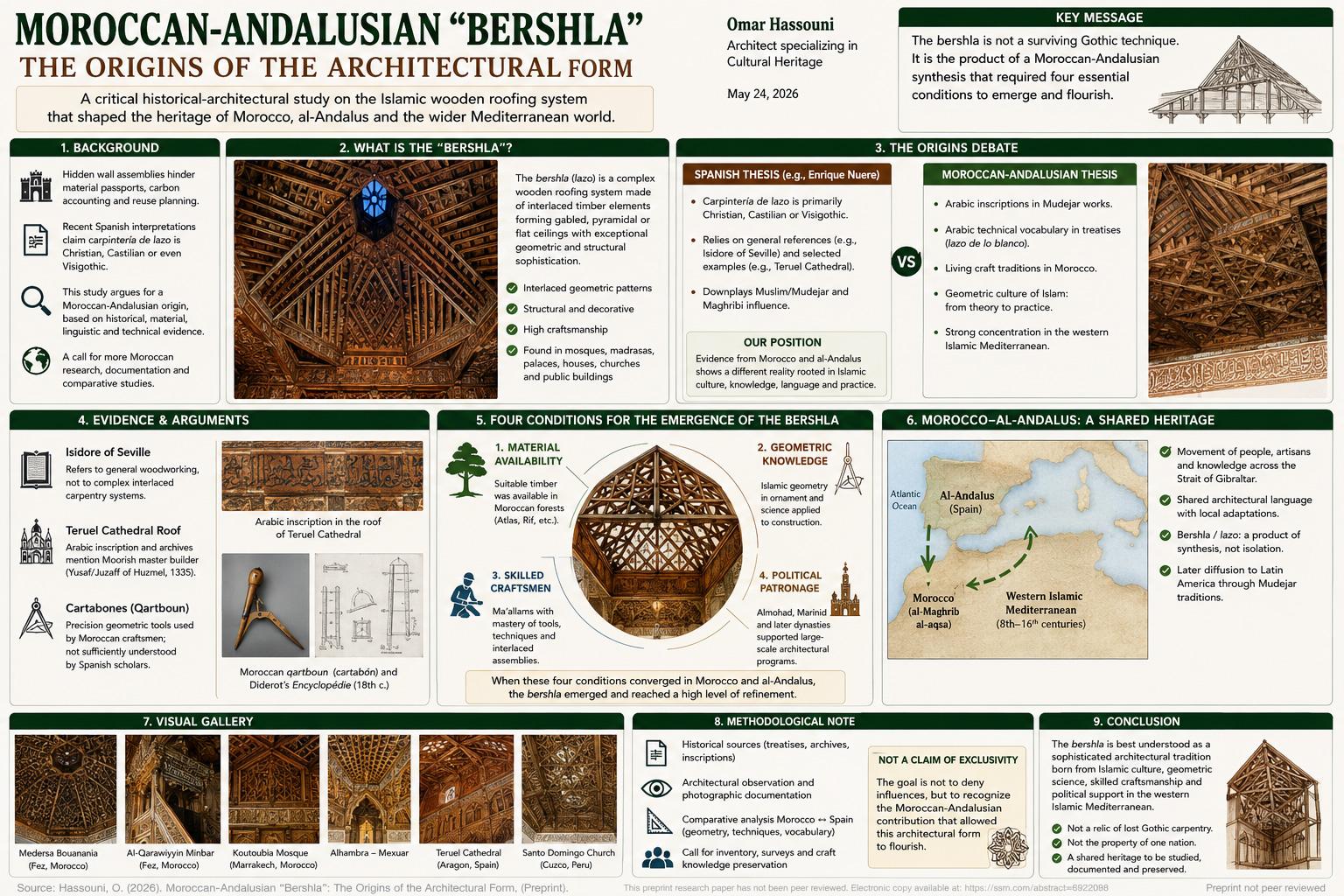
Omar Hassouni’s paper focuses on an architectural form that is visually powerful but historically under-studied: the Moroccan-Andalusian bershla. In broad terms, a bershla is a wooden roofing or ceiling system made through complex timber carpentry, geometric interlacing, and decorative structural organization. In Spanish discussions, related forms are often described through terms such as lazo, carpintería de lazo, carpintería de lo blanco, and Mudejar carpentry. The paper’s purpose is not only to describe these roofs aesthetically, but to ask where this architectural form came from and how its origin should be interpreted.
The problem is important because architectural heritage is not only a question of style. It is also a question of cultural memory, craft transmission, historical authorship, and the interpretation of shared Mediterranean history. If a complex wooden roof is described as purely Christian, Castilian, or Visigothic, that interpretation changes how people understand Islamic architecture, Moroccan craftsmanship, Mudejar heritage, and the transmission of geometric knowledge across the Strait of Gibraltar. Hassouni argues that some recent Spanish interpretations risk minimizing or displacing the Muslim and Moroccan-Andalusian dimension of this architectural tradition.
The paper begins by presenting the bershla as a form characteristic of the western Islamic world, especially Morocco and Muslim al-Andalus. The author notes that such wooden gable roofs and ceilings appear in historic Moroccan cities and in the broader Hispanic world, including South America, Mexico, and Chile, where they are often associated with the Mudejar style. This already shows that the form cannot be treated as a minor local curiosity. It belongs to a wide architectural history that crosses Morocco, Spain, and later colonial Hispanic territories.
Page 2 contains a photograph of a Moroccan bershla in the Bouanania Latrine in Fez, taken by the author. This image is important because it grounds the discussion in a real Moroccan monument rather than in abstract historiography. The roof appears as a dense, dark, highly patterned wooden surface with a small blue-lit opening. The visual impression is of a spatial canopy whose decorative effect is inseparable from carpentry technique. The image does not prove an origin by itself, but it makes clear why the author treats the bershla as a major architectural and craft object rather than a decorative afterthought.
Page 3 shows another detail of the Bouanania Latrine bershla. This closer view makes the interlaced and perforated timber pattern more visible. The image helps the reader understand the technical complexity behind the paper’s argument. The question is not simply whether people in Late Antiquity had carpenters or timber roofs. The question is how a sophisticated system of interlaced geometry, timber cutting, ornamental repetition, and structural carpentry emerged. The photograph supports the author’s insistence that the bershla is a complex architectural system requiring specialized knowledge.
The paper identifies the bershla as one of the significant architectural elements of traditional Moroccan-Andalusian architecture. These roofs appear in mosques, madrasas, palaces, religious institutions, public facilities, houses, and elite domestic architecture. According to Hassouni, they became fundamental features of Moroccan and Moroccan-Andalusian buildings at least by the Marinid period, and possibly earlier under the Almohads, although the author acknowledges that direct material evidence from the earlier Almohad phase is limited. This caution is important: the paper does not claim that every early stage is fully documented. It argues from a combination of historical, material, technical, and cultural clues.
The author’s main methodological move appears in Section 3. Rather than simply asserting a Moroccan or Islamic origin, he proposes to examine the arguments made in Spain for a non-Muslim origin and compare them with historical and architectural evidence from both shores of the Mediterranean. This gives the paper a polemical but structured character. It is not neutral cataloguing; it is a critical response to a historiographical position that the author sees as historically misleading.
A major figure in the paper is Enrique Nuere Matauco, a Spanish architect and carpenter known for studying carpintería de lazo and for interpreting the seventeenth-century treatise of Diego López de Arenas. Hassouni recognizes Nuere’s technical importance. The paper repeatedly makes clear that Nuere’s contribution to the recovery of geometric and carpentry knowledge is substantial. The disagreement is not about whether Nuere studied the technical system seriously. The disagreement concerns the historical conclusions Nuere draws from that technical knowledge.
According to the paper, Nuere and some related Spanish interpretations argue that carpintería de lazo should not be described as Mudejar or Muslim, but rather as a Christian, Castilian, or even Visigothic carpentry tradition. Hassouni sees this as problematic because, in his view, the evidence used to support such a claim is weak, indirect, or speculative. The paper therefore separates technical expertise from historical attribution. A scholar can be technically brilliant in reconstructing geometry and still overextend the historical interpretation.
The author also criticizes the lack of Moroccan scholarship on the subject. This is one of the most self-critical and constructive parts of the paper. Hassouni does not simply blame Spanish researchers for misinterpretation. He argues that Morocco has not studied this heritage sufficiently, despite its importance. He lists several reasons: many Moroccans assume the origin is self-evident and therefore does not need proof; the roofs are often hard to access because they are high, dark, deteriorated, or located in administratively difficult monuments; and many researchers lack the geometric knowledge needed to survey and classify such structures. This is a crucial point because the absence of research creates space for others to define the historical narrative.
The paper therefore calls for a systematic inventory and classification of Moroccan bershlas, especially in cities such as Fez, Marrakech, Rabat, Salé, Meknes, and other historic urban centers. It also calls for comparison with Spanish examples in Seville, Granada, Toledo, and other places. This future research agenda is one of the paper’s practical contributions. The author is not only arguing about the past; he is asking for documentation, measurement, geometric survey, and preservation work that could clarify the history more rigorously.
Section 4 summarizes Spanish research. According to Hassouni, Spanish scholars have produced a large body of work since the 1980s, including structural studies, historical studies, catalogues, doctoral theses, books, and reconstructions of carpentry methods. Nuere’s work on Diego López de Arenas is presented as foundational in this modern Spanish revival of knowledge. However, the author argues that Spanish research has often looked insufficiently beyond Spain and has treated Moroccan evidence superficially. This has contributed, in his view, to an incomplete understanding of Moroccan craftsmen and their surviving knowledge.
The paper then moves to its central thesis: the emergence of a traditional architectural element requires four conditions. These are raw material, theoretical and geometric knowledge, skilled craftsmen, and political patronage. This is one of the clearest conceptual frameworks in the paper. It avoids a simplistic “who invented it?” question and instead asks what historical conditions make such an architectural form possible.
The first condition is material availability. The bershla is made of wood, and not all regions have equal access to suitable timber. Hassouni argues that Moroccan forests, especially in the Atlas, provided the kind of wood needed for such carpentry: strong enough for construction, but workable enough for cutting and assembly. The author also notes that the eastern Islamic world did not produce this specific type of gable roof in the same way, which he uses to underline the importance of local material conditions. This is a persuasive material argument, although it would benefit from more detailed botanical, archival, and construction data in future work.
The second condition is theoretical knowledge, especially geometry. The paper argues that geometric principles were already present in Islamic ornament and smaller wooden constructions before the full development of bershla roofs. The author points to famous minbars, including those associated with the Qarawiyyīn Mosque in Fez and the Koutoubia Mosque in Marrakech, where characteristic geometric cut-outs and cutting angles can already be observed. This matters because the bershla is not only a structural roof. It is a geometric and ornamental system. The author links this broader geometric culture to Islamic scientific traditions, including Abū al-Wafāʾ al-Būzjānī’s work on the geometry needed by artisans.
No mathematical formula is presented in the paper, but the argument repeatedly depends on applied geometry. In simple terms, the bershla requires the ability to translate geometric patterns into timber pieces that can be cut, joined, repeated, and assembled into a roof or ceiling. Geometry here is not abstract classroom mathematics. It is practical construction knowledge. It determines angles, interlacing, proportions, modules, and the relationship between decorative pattern and structural form.
The third condition is skilled labor. The author emphasizes the role of traditional craftsmen, or maallams, capable of producing complex carpentry. This is important because architectural form does not arise from drawings alone. It requires embodied skill: measuring, cutting, joining, correcting, sequencing, and transmitting knowledge through workshop practice. The paper argues that such expertise existed in Morocco and al-Andalus and remained alive in Moroccan craft traditions, even if not always formalized in written treatises.
The fourth condition is political will, which the author considers perhaps the most decisive. Complex wooden roofs require patrons who can finance them and institutions that want them. Hassouni links this to the Almohad and Marinid periods, arguing that political transformation produced new architectural choices. The author sees the Almohad period as a moment of architectural rupture after the decline of the Almoravids, with a more sober and economical architectural language that used timber in new ways. This is an ambitious historical argument. It is plausible as a framework, but the paper itself acknowledges that more material and chronological evidence is needed for early phases.
The paper’s critique of a purely Visigothic or Christian origin proceeds through several arguments. The first concerns Isidore of Seville. Nuere uses references in Isidore’s Etymologies to suggest that wooden cupolas or timber roofing traditions were present in pre-Islamic Iberia. Hassouni responds that Isidore’s passages refer only to general woodworking trades and simple timber vaults or roof-beam arrangements. They do not describe complex interlaced carpentry comparable to the bershla. In everyday terms, evidence that a society had carpenters does not prove that it had this particular system of geometric wooden roofing.
This distinction is very important. Technical continuity does not automatically prove formal continuity. Many cultures had carpenters. Many regions used wooden roofs. That does not mean they produced carpintería de lazo. Hassouni’s objection is that Nuere moves too quickly from general carpentry to a specific, highly developed system of interlaced roof geometry.
The second debated example is the timber roof of the Cathedral of Teruel in Aragon. Nuere treats Teruel as one of the oldest surviving examples of lazo carpentry in Spain and uses it to challenge the classification of such carpentry as Mudejar. Hassouni questions this interpretation. He argues that the roof contains Arabic inscriptional evidence and that archival information points to work in 1335 under the direction of Yusaf or Juzaff of Huzmel, described in Spanish sources as a Moorish master builder. In the author’s view, this makes it difficult to use Teruel as proof of a purely Christian authorship.
Page 9 contains a reproduced drawing or image associated with timber roof decoration, including an Arabic inscription beneath a patterned structural band. This visual is used to challenge the idea that the tradition can be detached from Islamic cultural context. It does not by itself settle the authorship question, but it gives concrete visual weight to the author’s claim that Arabic epigraphy and Islamic decorative vocabulary must be taken seriously.
Page 10 shows images reproduced from Nuere’s e-book, including painted worker scenes and a darker-skinned Muslim knight figure. Hassouni criticizes the use of skin color as evidence of religious identity. This is an important methodological point. Visual representation of skin tone in medieval or later painted decoration cannot reliably identify whether workers were Christian, Muslim, Castilian, Toledan, Aragonese, or Mudejar. The paper argues that such reasoning is historically fragile and should not serve as proof of origin.
Page 11 shows an inscription from the roof of the Cathedral of Teruel. Hassouni uses this visual evidence to reinforce his argument that the roof cannot be treated as straightforward proof of an exclusively Christian origin. He also compares Teruel with the gable roof of the Seffarine Madrasa in Fez, dated to the second half of the thirteenth century and often considered among the earliest known examples of advanced lazo carpentry. The key point is chronological caution: the priority of Iberian examples is not as secure as some claims suggest.
The third major issue concerns cartabones. In Spanish carpentry studies, a cartabón is associated with drawing and cutting tools used to control angles and geometric layouts. Nuere gives these tools a central role in explaining the Spanish tradition. Hassouni responds by pointing to Moroccan use of the term cartabón or qartboun, which refers to a different precision instrument known among Moroccan craftsmen. The author argues that this Moroccan tool tradition has not been properly understood by Spanish scholars.
Page 12 contains images illustrating cartabón tools and geometric drawing/cutting instruments. One image shows triangular red geometric elements used in relation to carpentry layout. Another image reproduces a plate from Diderot’s Encyclopédie, where a tool similar to the Moroccan cartabón is visible. A third image refers to an Italian precision instrument. These visuals matter because the discussion is not merely linguistic. The author is arguing that tool history, craft terminology, and geometric practice are connected, and that Moroccan craft traditions may preserve knowledge not adequately captured by Spanish written narratives.
The fourth argument concerns written transmission. Spanish scholars have a major textual source: Diego López de Arenas’ seventeenth-century treatise on carpintería de lo blanco. Hassouni acknowledges the importance of this source. But he emphasizes that the technical vocabulary in the treatise is heavily Arabic or Arabic-derived. Terms such as alarife, almisate, ataujía, and alfarda indicate, in the author’s view, a Moroccan-Andalusian technical lexicon. The paper asks a direct question: if this craft were fundamentally inherited from Christian Castilian forefathers, why is its specialized vocabulary so strongly Arabic?
This is one of the paper’s stronger historiographical points. Technical vocabulary is not absolute proof of origin, but it is meaningful evidence. Crafts tend to preserve words through practice. If a body of carpentry knowledge is transmitted through Arabic-derived terms, that suggests deep cultural contact with Islamic or Andalusian craft worlds. Nuere’s explanation, according to Hassouni, does not fully resolve this problem because it assumes that craftsmen adopted Arabic terminology while preserving a pre-existing Christian practice. Hassouni sees this as possible in theory but insufficiently proven.
Section 6 evaluates Nuere’s broader thesis. Hassouni’s position is balanced in one important sense: he does not deny that Visigothic Spain had carpenters or that Romanized and late antique traditions continued into the early medieval period. He accepts that wooden craft existed before Islam in Iberia. But he argues that this general continuity does not explain the emergence of complex lazo carpentry. The real question is not whether carpenters existed, but whether they produced a comparable geometric, structural, and decorative system.
The author also questions the geographic logic of a northern European or purely Christian origin. If carpintería de lazo were a direct heir of Christian or Gothic timber traditions from forest-rich northern Europe, one might expect similar forms to be widespread in France, England, Italy, or northern Europe. Instead, the most successful and distinctive forms are concentrated in the western Islamic zone, especially Morocco and al-Andalus. This geographic concentration supports the idea of a Moroccan-Andalusian or western Islamic synthesis rather than a simple Gothic survival.
The paper’s discussion of Byzantine continuity is also interesting. Hassouni does not present Muslims and Visigoths as completely disconnected from the ancient world. He notes that the Umayyads came from a Syrian environment marked by Romano-Byzantine heritage and that Islam in al-Andalus was shaped by many continuities and transformations. This helps avoid a simplistic opposition between “Islamic” and “European.” The author’s preferred explanation is synthesis: craft traditions, geometry, ornament, materials, and political contexts combined in the western Islamic Mediterranean to produce something specific.
The conclusion argues that historical Morocco and al-Andalus formed, for centuries, a shared political and cultural space under Muslim rule. Therefore, similar techniques on both sides of the Strait of Gibraltar should not surprise us. The paper’s final position is that the bershla is best understood as a common heritage of the Moroccan-Andalusian sphere, rather than as a purely Hispanic, Gothic, or Castilian invention. The author also suggests that Morocco was a central political pole in this shared cultural environment, especially through Fez and Marrakech.
The strongest contribution of the paper is its challenge to overly narrow origin narratives. It reminds readers that architectural forms emerge from systems: material availability, geometric knowledge, trained craftsmen, patronage, political power, vocabulary, tools, monuments, and memory. A roof is not only a roof. It is the visible result of a craft culture.
The paper also has limitations. It is not a full archaeological study. It does not provide a complete inventory of Moroccan and Spanish bershlas. It does not present measured geometric surveys, dendrochronology, material dating, wood-species analysis, structural analysis, or a complete chronological database. It is primarily a critical historical and architectural argument. Its claims would be strengthened by systematic documentation, direct comparison of roof geometries, archival study, material dating, and interviews with living Moroccan craftsmen.
Another limitation is tone. The paper is strongly engaged in correcting what the author sees as Spanish misrepresentation. That gives it urgency, but it also means the argument is not written as a neutral survey. Readers should understand it as a position paper in a contested historiographical field. Its value lies in opening critical questions and identifying evidence that has been neglected, not in closing the debate once and for all.
For cultural heritage studies, the article is valuable because it insists that living craft traditions must be taken seriously. Written sources are important, but they are not the only form of knowledge. Moroccan craftsmen may preserve rules, tools, gestures, and geometric procedures orally and practically. If researchers look only for written treatises, they may wrongly assume that knowledge is absent. This is especially relevant for traditional architecture, where many techniques are transmitted through apprenticeship rather than books.
For architectural history, the paper encourages a more careful distinction between structure, ornament, technique, and historical origin. A timber roof may share basic structural features with earlier carpentry, but the interlaced geometric system may belong to another cultural and technical development. Similarly, a tool may exist in one region, but its use within a specific design logic may have a different history. These distinctions matter because heritage claims often become oversimplified.
For future research, the paper points toward several concrete tasks. First, Moroccan bershlas should be inventoried systematically across major historic cities. Second, their geometry should be surveyed and classified. Third, examples should be compared with Spanish and Mudejar roofs using consistent criteria. Fourth, craft vocabulary should be documented among Moroccan carpenters. Fifth, physical evidence such as timber species, construction phases, inscriptions, repairs, and reused elements should be studied. Sixth, the history of patronage under Almohad, Marinid, Nasrid, and later dynasties should be linked to surviving examples.
The broader meaning of the paper is that heritage cannot be separated from how history is written. When one scholarly tradition produces abundant publications and another leaves its monuments under-documented, the published narrative can become unbalanced. Hassouni’s article is therefore also a call to research responsibility. The bershla is not only an object of beauty; it is a historical archive made of wood, geometry, craft memory, and political culture. To understand it properly, both shores of the western Mediterranean must be studied together.
Source and Method Note
The source analyzed here is Moroccan-Andalusian “Bershla”: The Origins of the Architectural Form by Omar Hassouni, identified in the PDF as an architect specializing in cultural heritage. The document is dated May 24, 2026. It is described in the comments section as an English working-paper version of a French-language article, enriched and translated by the author for wider international readership.
The source type is best described as a working paper / technical historical-architectural manuscript. The PDF does not show a DOI, journal name, volume, issue, conference acceptance, academic publisher, or formal peer-review statement. Therefore, the peer-review status is not clearly peer reviewed. The PDF does not explicitly state “This preprint research paper has not been peer reviewed,” but because no peer-reviewed publication information is visible, the work should be treated cautiously as a non-certified scholarly working text rather than a peer-reviewed article.
The paper’s method is historical-architectural argumentation and critical historiographical analysis. It reviews claims made in Spanish scholarship, especially work associated with Enrique Nuere Matauco, and compares those claims with architectural, linguistic, craft, documentary, and cultural evidence related to Moroccan-Andalusian wooden roofs. It also discusses Diego López de Arenas, Basilio Pavón Maldonado, Isidore of Seville, Mudejar terminology, Arabic technical vocabulary, Moroccan craft practice, and geometric tool traditions such as the cartabón or qartboun.
The study does not present an archaeological excavation, laboratory material analysis, dendrochronological dating, statistical dataset, complete monument catalogue, measured geometric survey, structural engineering model, or newly documented field inventory. Its evidence base consists of published historical references, critique of secondary scholarship, visual examples, author photographs, reproduced images from other sources, and architectural reasoning. Its conclusions should therefore be read as a critical interpretive argument requiring further empirical documentation.
The PDF includes several important visuals. Page 2 shows a Moroccan bershla in the Bouanania Latrine in Fez, photographed by the author, illustrating the dense timber geometry and spatial effect of the roof. Page 3 shows a closer detail of the same Moroccan bershla, emphasizing the interlaced pattern and craft complexity. Page 9 includes an image associated with roof decoration and Arabic inscriptional context, used in the discussion of Isidore of Seville and Spanish-origin arguments. Page 10 reproduces images from Nuere’s e-book, including painted worker scenes and a mounted figure, which the author critiques as weak evidence for religious or ethnic attribution. Page 11 shows an inscription from the roof of the Cathedral of Teruel, used to question an exclusively Christian origin claim. Page 12 shows images related to cartabón tools and precision instruments, supporting the discussion of applied geometry and Moroccan craft terminology.
No mathematical formulas are provided in the PDF. However, the paper discusses applied geometry throughout. The geometric content concerns interlaced timber patterns, cutting angles, drawing tools, cartabones, proportional layout, and the practical transformation of ornamental geometry into wooden roof construction. These geometric ideas are explained here for educational purposes, not as engineering certification or restoration instructions.
This article is not an official heritage designation, conservation approval, engineering certification, restoration manual, legal ruling, religious judgment, political claim, archaeological proof, or state heritage policy. It explains a historical and architectural argument about the origins of the Moroccan-Andalusian bershla. Because the source is not clearly peer reviewed and does not present a complete empirical survey, its conclusions should be interpreted as a scholarly working argument that would benefit from further comparative research, measured documentation, archival study, material dating, and direct engagement with living Moroccan craft traditions.