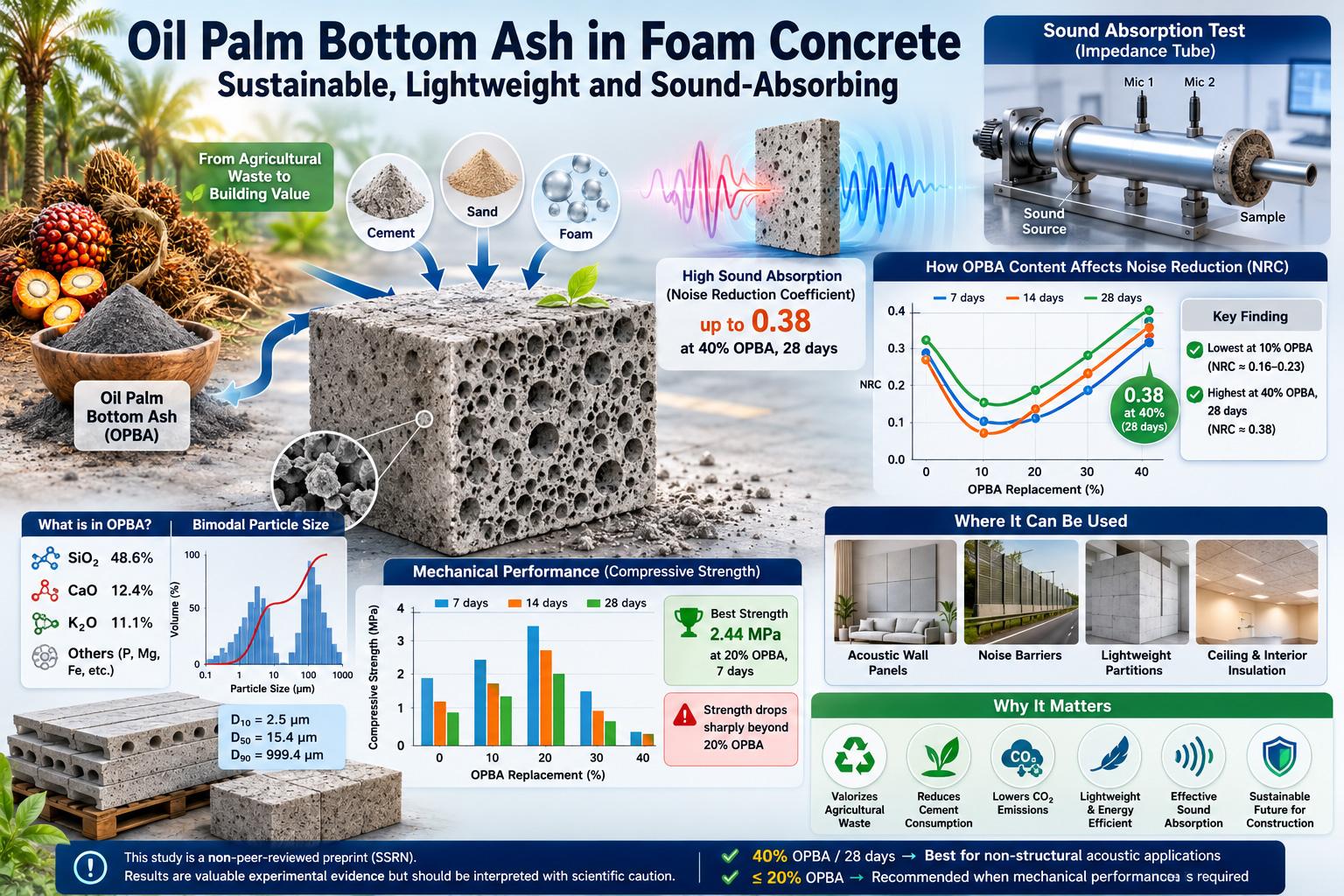
This study focuses on a practical materials engineering problem: how to make foam concrete more sustainable and acoustically useful without destroying its mechanical function. Foam concrete is already valued in construction because it is lightweight, easy to place, thermally insulating, and naturally porous. Its cellular pore structure also gives it potential as a sound-absorbing material. However, ordinary foam concrete has limitations. It is weaker and more brittle than normal concrete, and its sound absorption can vary depending on pore structure, density, and mix design. The study asks whether oil palm bottom ash can improve this material, especially for acoustic applications.
The environmental background is important. Oil palm production generates large quantities of biomass ash after combustion of oil palm residues. In Thailand, the paper states that the oil palm industry generates approximately 0.46 million tonnes of palm oil fuel ash annually. Much of this residue is disposed of near processing plants instead of being used beneficially. If such ash can replace part of Portland cement in foam concrete, two sustainability gains become possible: agricultural waste can be diverted from landfill, and cement demand can be reduced. This matters because cement production is energy-intensive and contributes significantly to carbon dioxide emissions.
The authors estimate that at a 40% replacement level, each cubic meter of OPBA foam concrete can divert approximately 133–200 kg of ash from landfill while reducing Portland cement demand by 40%. This is one of the strongest practical claims in the paper because it links laboratory material design to circular economy logic. The study is not merely asking whether ash can be added to concrete; it is asking whether an agricultural residue can become a functional component of sustainable building materials.
The specific waste material studied is oil palm bottom ash, abbreviated as OPBA. Bottom ash differs from fly ash in particle behavior, morphology, and possible reactivity. OPBA is not treated in the paper as a magical cement substitute. The authors carefully characterize it as a silica-rich material dominated by crystalline quartz and cristobalite, with additional compounds such as calcium magnesium potassium phosphate and calcite. This is important because crystalline silica is generally less reactive than amorphous silica under ordinary curing conditions. Therefore, much of OPBA’s effect in this study comes from its physical role as a filler and pore-structure modifier, rather than from strong pozzolanic chemical reaction.
The study’s research gap is clear. Foam concrete has been studied as a lightweight and porous material. Ash-based materials have also been investigated as cement replacements. Some previous work has examined coal bottom ash or other waste aggregates for acoustic absorption in concrete. However, the specific effect of oil palm biomass-derived bottom ash on foam concrete’s sound absorption, pore architecture, and mechanical performance has not been systematically characterized. The authors address this gap by testing both acoustic and mechanical outcomes across different OPBA replacement levels and curing times.
The experimental design uses five bottom ash replacement levels: BA-0, BA-10, BA-20, BA-30, and BA-40. These correspond to 0%, 10%, 20%, 30%, and 40% OPBA replacement by mass in the cementitious component. The control mix uses a sand:cement:OPBA ratio of 100:100:0. The replacement mixes use ratios of 100:90:10, 100:80:20, 100:70:30, and 100:60:40. The water-to-binder ratio is fixed at 0.46 for all mixes, which is important because it keeps water availability comparable while the cement-to-ash proportion changes.
Figure 1 on page 5 shows the full sample preparation workflow. The diagram begins with raw materials: Portland cement, sand, and oil palm bottom ash. It then shows dry mixing, water mixing, foam incorporation, casting into cylindrical molds, initial curing, water curing for 7, 14, and 28 days, and finally testing. The testing stage includes compressive strength testing, optical microscopy for microstructure, and sound absorption testing with an impedance tube. This figure is useful because it makes the study’s experimental sequence transparent: the researchers did not only prepare concrete cubes or cylinders and test strength; they connected mix design, curing, microstructure, acoustics, and mechanics in one workflow.
The foam incorporation step is especially important. The authors add commercial concrete foam at 50% volume relative to the premixed solid constituents. In foam concrete, the foam creates air voids that reduce density and can improve sound absorption. But those same pores can also weaken the material. Therefore, the study is really about balancing two competing effects: more porosity can help acoustic dissipation, but too much or poorly connected porosity can reduce compressive strength.
The material characterization begins with X-ray fluorescence, or XRF, which identifies elemental composition. Table 1 on page 8 reports that OPBA contains 43.1% oxygen, 22.7% silicon, 9.2% potassium, 8.8% calcium, 3.6% nitrogen, 3.1% carbon, 3.0% phosphorus, and 2.6% magnesium. The authors further state that compound analysis indicates silica, SiO₂, at 48.6%, calcium oxide at 12.4%, potassium oxide at 11.1%, phosphorus pentoxide at 6.9%, magnesium oxide at 4.3%, and iron oxide at 2.3%. These chemical findings matter because they explain why OPBA can participate in the foam concrete matrix as a mineral filler, while also introducing alkali and phosphate phases that may affect hydration and long-term water exposure.
Figure 3 on page 8 contains two important panels. Figure 3(a) shows X-ray diffraction patterns and phase peak identification for OPBA. The authors identify quartz and cristobalite, both forms of silica, along with calcium magnesium potassium phosphate and calcite. This confirms that the ash is mineralogically complex and that its silica is largely crystalline. Figure 3(b) shows the particle size distribution. This is central to the paper’s argument because OPBA has a bimodal distribution: a fine particle population and a coarse particle population.
The particle size data are very specific. The paper reports D₁₀ = 2.5 μm, D₅₀ = 15.4 μm, and D₉₀ = 999.4 μm. In practical terms, D₁₀ means 10% of the particles are smaller than about 2.5 micrometers, D₅₀ means half the particles are smaller than about 15.4 micrometers, and D₉₀ means 90% are smaller than about 999.4 micrometers. This wide range means OPBA contains both fine particles that can fill voids and coarse agglomerated particles that can disrupt the foam matrix. That dual behavior helps explain the study’s mixed results: low-to-moderate OPBA can reinforce or fill the matrix, but high OPBA can enlarge pores and weaken load-bearing continuity.
The optical microscopy results are shown in Figure 4 on page 10. The figure compares BA-10, BA-20, BA-30, and BA-40 foam concrete samples after 7 days of water soaking. The control mix is not included in this micrograph set. The images show that BA-10 has smaller pores and less pronounced interconnection between pores. As OPBA content increases to BA-20, BA-30, and especially BA-40, the pores become larger and more interconnected. In BA-40, unreacted OPBA particles are more visible. This visual evidence supports the paper’s key mechanism: at high replacement levels, OPBA creates a more open and irregular pore network that helps sound absorption but harms mechanical strength.
This is an important point for general readers. Sound absorption in porous materials depends on air movement inside pores. When sound waves enter a connected pore network, acoustic energy can be dissipated as heat through viscous friction and internal scattering. Larger or more interconnected pores can allow more sound energy to enter the material. But concrete strength depends on a continuous solid skeleton. If pores become too large or too connected, and if unreacted ash particles interrupt the cement matrix, the material becomes weaker. Therefore, the same microstructure that helps acoustic absorption can reduce compressive strength.
The density results are presented in Figure 5 on page 11. The contour plot shows density values ranging approximately from 592 to 799 kg/m³. The highest densities, about 757–799 kg/m³, occur in the 0% bottom ash specimens. As BA content increases from 0% to 40%, density declines, with the lowest values, about 592–633 kg/m³, observed at 30–40% BA after 7 days. This confirms that OPBA makes the foam concrete lighter, partly because OPBA is porous and partly because higher OPBA levels alter pore structure. The figure also shows that curing duration has a smaller effect than BA content, especially above 20% replacement.
The acoustic testing method is shown in Figure 2 on page 7. The researchers use a two-microphone impedance tube system designed according to ASTM E1050 and ISO 10534 standards. The tube has a diameter of 28.6 mm and a length of 1,000 mm. Cylindrical specimens with a diameter of 28.6 mm and thickness of 40 mm are tested. The effective frequency range is 200–5000 Hz. This means the paper measures normal-incidence sound absorption, not real-room diffuse-field absorption. That distinction matters: impedance tube data are controlled and useful for material comparison, but they do not fully represent how panels behave in an actual room or building installation.
Figure 6 on page 12 shows sound absorption coefficient spectra for samples soaked for 7, 14, and 28 days. Across the spectra, absorption is low below about 1000 Hz, around 0.1–0.2, and then rises in the 1000–4000 Hz region, often reaching 0.35–0.45, with some high-BA specimens exceeding 0.5 at certain frequencies. This frequency pattern is typical of porous absorbers. Low-frequency sound has longer wavelengths that do not couple as easily into small pore structures, while mid- and high-frequency sound is more effectively dissipated inside the pore network.
One of the most interesting findings in Figure 6 is that BA-10 behaves as an outlier with generally lower average sound absorption. This is counterintuitive because one might expect any porous ash addition to improve acoustic performance. The authors explain that at 10% BA, ash particles may partially obstruct the existing foam pore network without yet creating enough new acoustic pathways. In other words, a small amount of OPBA can disturb the original foam concrete’s pore structure more than it helps it. This explains why the relationship between OPBA and sound absorption is not a simple “more ash always equals better absorption” pattern.
Figure 7 on page 13 provides contour plots for acoustic indicators: noise reduction coefficient, low-frequency absorption αL, mid-frequency absorption αM, and high-frequency absorption αH. The NRC plot shows a U-shaped dependence on BA content. The lowest values appear around 10% BA, approximately 0.16–0.23 depending on curing age. Higher absorption appears at both 0% BA and 40% BA, with the best acoustic condition at 40% BA and 28 days. The abstract and conclusion report that the peak NRC reaches approximately 0.38 for 40% BA at 28 days.
This U-shaped pattern is one of the paper’s most important contributions. It shows that OPBA has two regimes. At low replacement, especially 10%, OPBA may disrupt the beneficial pore network of plain foam concrete. At higher replacement, especially 30–40%, OPBA’s own microporosity and larger inter-particle channels dominate, improving acoustic absorption. The practical meaning is that a designer should not assume that a small OPBA addition is automatically beneficial for acoustics. The material must be optimized for the intended function.
The low-frequency absorption result is especially relevant. The paper states that αL increases more gradually toward high BA content and reaches approximately 0.32–0.35 at 40% BA and 28 days. Low-frequency noise is difficult to absorb with thin lightweight materials, so even moderate improvement can be valuable for building applications. The authors argue that the primary added acoustic value of OPBA lies in improving low-frequency absorption while also valorizing agricultural waste.
Mid- and high-frequency absorption behave differently. Figure 7(c) and Figure 7(d) show that αM and αH have narrower dynamic ranges than low-frequency absorption or NRC. This suggests that the base foam concrete already dissipates mid- and high-frequency sound reasonably well. OPBA can improve these bands, but its strongest distinctive benefit is not simply making all frequencies better. It mainly changes the pore architecture in a way that improves broader and especially lower-frequency absorption when replacement is high enough.
The mechanical results are shown in Figure 8 on page 15. This figure is essential because it reveals the cost of acoustic improvement. Compressive strength peaks at about 2.44 MPa for 20% BA after 7 days. At 10% BA after 7 days, compressive strength is approximately 1.54–1.99 MPa. The reference 0% BA formulation at 28 days reaches around 1.54 MPa. But beyond 20% BA, strength collapses sharply. The paper reports that 30% BA specimens remain around 0.64 MPa and 40% BA specimens around 0.19 MPa across soaking durations.
This mechanical collapse is not a small detail. It defines what the material can and cannot be used for. A 40% OPBA mix may be acoustically attractive, but it is not suitable for structural loading. The authors state that BA-30 and BA-40 are suitable only where acoustic panel performance governs the design, not where structural strength is required. Formulations up to 20% BA retain compressive strength above a practical lower bound of approximately 0.7 MPa for lightweight non-structural foam concrete applications. This means the material is more suitable for non-load-bearing panels, partitions, acoustic liners, and similar uses than for structural members.
The elastic modulus data in Figure 8 reinforce the same trade-off. The initial modulus peaks at about 24.35 MPa for 20% BA at 7 days. The tangent modulus peaks at about 109.75 MPa for 10% BA at 7 days. The secant modulus peaks at about 50.10 MPa for 10% BA at 14 days. Although the exact optimum differs by stiffness measure, the mechanically superior range is consistently 10–20% BA. At 30–40% BA, stiffness falls toward the lower end of the scale. This is consistent with a matrix that becomes too porous and discontinuous as ash replacement increases.
A particularly counterintuitive finding is that prolonged water curing reduces mechanical performance in OPBA mixes instead of improving it. In ordinary cement systems, longer curing often improves strength because hydration continues. In this study, the control mix can still gain strength through hydration, but OPBA mixes often lose mechanical performance as water soaking extends from 7 to 28 days. The authors attribute this to calcium ion leaching and potassium salt dissolution in the highly porous matrix, which can soften the interfacial zones and increase porosity. This finding matters for durability: OPBA foam concrete may need careful evaluation under long-term moisture exposure before being used in wet or humid environments.
The chemical explanation is linked to the mineralogical data. OPBA contains calcium, potassium, phosphate-bearing phases, and crystalline silica. Calcite may provide nucleation surfaces that help early hydration at low-to-moderate OPBA levels. Fine silica-rich particles may improve packing. But at higher OPBA contents, crystalline quartz and cristobalite do not meaningfully contribute to binder gel formation under normal curing. Instead, the growing volume of inert, porous ash reduces the continuity of the hydrated cement paste. Potassium-bearing phases may dissolve during water soaking, and phosphate phases may retard hydration. These mechanisms explain why the material’s behavior changes so strongly with replacement level.
The statistical analysis in Table 2 on page 18 uses two-way ANOVA to test the influence of OPBA content and curing day. The authors examine density, NRC, low-, mid-, and high-frequency absorption, compressive strength, initial modulus, tangent modulus, and secant modulus. OPBA content is statistically significant for density, all acoustic responses, compressive strength, tangent modulus, and secant modulus. For many acoustic properties, p-values are below 0.001. This confirms that BA percentage is the primary factor governing both acoustic and mechanical behavior.
Curing day has a more selective effect. It is significant for NRC, αL, and αM, but not for αH, compressive strength, or the stiffness moduli within the 7–28 day range. The interaction between BA content and curing day is significant for several responses, including NRC, αH, compressive strength, tangent modulus, and secant modulus. This means the effect of OPBA is not identical at every curing age. The material response depends on the combination of mix design and curing duration.
The adjusted R² values provide another layer of caution. The model fits are moderate to strong for NRC and compressive strength, with adjusted R² values of about 0.668 and 0.797. However, the initial modulus has an adjusted R² of only 0.127 and a very high coefficient of variation of 68.3%. The authors explicitly note that conclusions based on initial modulus should be regarded as indicative trends rather than statistically robust findings. This is a responsible limitation and should not be ignored. Foam concrete is heterogeneous, and stiffness measurements can vary significantly because pores and ash particles are not perfectly uniform across specimens.
Figure 9 on page 20 shows property trends across BA content and curing age with Tukey HSD groupings. This figure helps identify which combinations are statistically among the highest-performing groups. For acoustic properties, the best groups generally appear at 0% and 40% BA, especially at 28 days. For mechanical performance, the strongest groups are clearer: compressive strength is highest at 20% BA and 7 days, while tangent modulus is highest at 10% BA and 7 days. This figure confirms that there is no single universal “best” mix. The best mix depends on whether the goal is sound absorption or mechanical strength.
The comparative study is summarized in Table 3 on page 21. The authors compare their NRC values with other cementitious porous acoustic materials. The present 10% OPBA foam concrete reaches NRC 0.23 at 40 mm thickness, while 40% OPBA foam concrete reaches NRC 0.38 at the same thickness. A mortar with 60% co-combustion bottom ash lightweight aggregate reaches NRC 0.25 at 40 mm. Pervious concrete with vermiculite reaches NRC 0.35 at 50 mm. Concrete with 80% bottom ash reaches NRC 0.32 at 40 mm. Crumb rubber concrete, cenosphere concrete, and alkali-activated cellular concrete show lower NRC values in the comparison. This indicates that 40% OPBA foam concrete is competitive with other waste-aggregate or porous cementitious acoustic systems.
The comparison should be read carefully. Different studies may use different specimen thicknesses, aggregate types, pore structures, and testing conditions. Therefore, Table 3 does not prove that OPBA foam concrete is universally superior to every alternative. It does show that its acoustic performance is within a practically interesting range, especially considering that it uses agricultural residue and a 40 mm specimen thickness.
The study’s final recommendation is clear. If the target application is a non-load-bearing acoustic panel, 40% OPBA with 28 days curing is the acoustic optimum. If the application requires structural or load-bearing performance, OPBA content should not exceed 20%. The strongest compressive result is 20% BA at 7 days, about 2.44 MPa, but higher replacement levels sacrifice strength too much. This distinction is the most important practical takeaway for engineers, designers, and material developers.
The study’s strongest contribution is the way it connects waste valorization, acoustic performance, microstructure, and mechanical limits. It does not only report that OPBA can be added to foam concrete. It explains why different replacement levels behave differently. Fine OPBA particles can help packing and reinforcement at low-to-moderate levels. Coarse and unreacted OPBA particles can enlarge pores and improve acoustic pathways at high levels. But too much OPBA reduces cement matrix continuity and weakens the material.
The study also has limitations. It is a preprint and has not been peer reviewed. The acoustic measurements are normal-incidence impedance tube measurements, not diffuse-field room-acoustic tests. The specimens are 40 mm thick, so thickness effects remain to be studied. The long-term durability of OPBA foam concrete under moisture cycling, repeated wet-dry conditions, freeze-thaw exposure, carbonation, and real building environments is not fully established. The study uses optical microscopy for pore observation, but more detailed pore network quantification through techniques such as micro-CT could strengthen future work. The mechanical variability of foam concrete, especially modulus measurements, also suggests that larger sample sizes and more robust statistical validation would be valuable.
The paper does not show that OPBA foam concrete is ready for all construction uses. It shows something more specific and still useful: OPBA can produce a lightweight, sustainable, acoustically effective foam concrete when the design target is non-structural sound absorption. It also shows that there is a real mechanical penalty at high replacement levels. This balance is important because sustainable materials must be evaluated honestly. A waste-based material is only beneficial if its performance fits the application.
For the construction sector, the practical meaning is straightforward. OPBA foam concrete may be useful in building envelopes, partition walls, acoustic panels, noise barriers, and other non-load-bearing components where sound absorption and low density are desirable. In these contexts, a 40% OPBA mix could reduce cement use and divert biomass ash from disposal while providing competitive acoustic absorption. For structural or load-sensitive components, lower OPBA levels, especially within the 10–20% range, are safer based on the mechanical results reported in this study.
For circular economy and agricultural waste management, the study provides a valuable route for turning oil palm biomass residue into construction material. Instead of treating bottom ash as a disposal problem, it can become a performance-modifying ingredient. However, this transformation requires proper characterization. Chemical composition, particle size, soluble alkali content, and pore effects all matter. Not every ash source will behave identically, so local OPBA supplies would need quality control before industrial use.
The broader lesson is that sustainable material design is not only about replacing cement with waste. It is about understanding how the replacement changes structure, performance, durability, and application boundaries. In this study, OPBA improves acoustic performance when used at high levels, but the same mechanism that improves sound absorption also reduces strength. The best material is therefore not the one with the highest waste content in every case. The best material is the one whose composition matches the intended function.
Source and Method Note
The source analyzed here is Acoustical and Mechanical Properties of Foam Concrete Incorporating Bottom Ash Filler Derived from Oil Palm Biomass by Kritsadi Thetpraphi, Sarawut Chulok, Nawarat Seetapong, Nasreen Dortha, Polphat Ruamcharoen, and Purintorn Chanlert. The authors are affiliated with Walailak University and Songkhla Rajabhat University in Thailand, including the Research Unit in Applied Physics and Advanced Materials.
The PDF explicitly states: “This preprint research paper has not been peer reviewed” and “Preprint not peer reviewed.” It also provides an SSRN electronic copy link. Therefore, the source type is a non-peer-reviewed SSRN preprint research paper. The findings should be interpreted as non-peer-reviewed preprint evidence. They are useful experimental results, but they should not be treated as a finalized peer-reviewed materials standard or certified engineering specification.
The study uses an experimental materials methodology. Foam concrete was prepared using Portland cement, sand, commercial concrete foam, water, and oil palm bottom ash collected from an oil palm processing factory in Satul Province, Thailand. OPBA replaced cement at 0%, 10%, 20%, 30%, and 40% by mass. The water-to-binder ratio was fixed at 0.46, and foam was incorporated at 50% by volume of the premixed solid constituents. Specimens were initially cured for 48 hours and then water-cured for 7, 14, or 28 days.
OPBA was characterized using X-ray fluorescence for elemental and compound composition, X-ray diffraction for crystalline phases, and laser diffraction for particle size distribution. Surface morphology was observed using optical microscopy. Mechanical properties were measured using a universal testing machine at a crosshead speed of 3 mm/min, with three cylindrical specimens tested for each mix and curing period. The mechanical responses included compressive strength, initial modulus, tangent modulus, and secant modulus.
Acoustical properties were measured using a custom-built two-microphone impedance tube system designed according to ASTM E1050 and ISO 10534. Cylindrical specimens had a diameter of 28.6 mm and a thickness of 40 mm. The effective frequency range was 200–5000 Hz. The study reports sound absorption coefficient spectra and derived acoustic indicators including NRC, αL, αM, and αH.
The paper includes several important figures and tables. Figure 1 on page 5 shows the full sample preparation and testing process. Figure 2 on page 7 shows the impedance tube sound absorption measurement system. Table 1 on page 8 reports OPBA elemental composition. Figure 3 on page 8 shows XRD patterns and particle size distribution. Figure 4 on page 10 shows optical microscope images of BA-10, BA-20, BA-30, and BA-40 microstructures. Figure 5 on page 11 maps density changes as a function of BA content and curing duration. Figure 6 on page 12 shows sound absorption spectra. Figure 7 on page 13 shows contour plots of NRC and frequency-band absorption. Figure 8 on page 15 shows contour plots of compressive strength and elastic moduli. Table 2 on page 18 reports ANOVA p-values and model quality indicators. Figure 9 on page 20 shows property trends with Tukey HSD groupings. Table 3 on page 21 compares NRC values with other cementitious acoustic materials.
The numerical findings should be understood within the study’s experimental conditions. The best acoustic result is reported at 40% BA / 28 days, with NRC approximately 0.38. The best compressive strength is reported at 20% BA / 7 days, approximately 2.44 MPa. Tangent modulus peaks at 10% BA / 7 days, approximately 109.75 MPa. Density ranges approximately from 592 to 799 kg/m³. The OPBA particle size distribution is reported as D₁₀ = 2.5 μm, D₅₀ = 15.4 μm, and D₉₀ = 999.4 μm.
This article is not an engineering certification, structural design approval, construction code approval, safety certification, environmental permit, investment advice, legal advice, health recommendation, or official policy directive. Because the study is a non-peer-reviewed preprint, its conclusions should be validated through peer review, durability testing, larger sample sets, real-environment acoustic testing, and application-specific engineering assessment before practical adoption in construction projects.