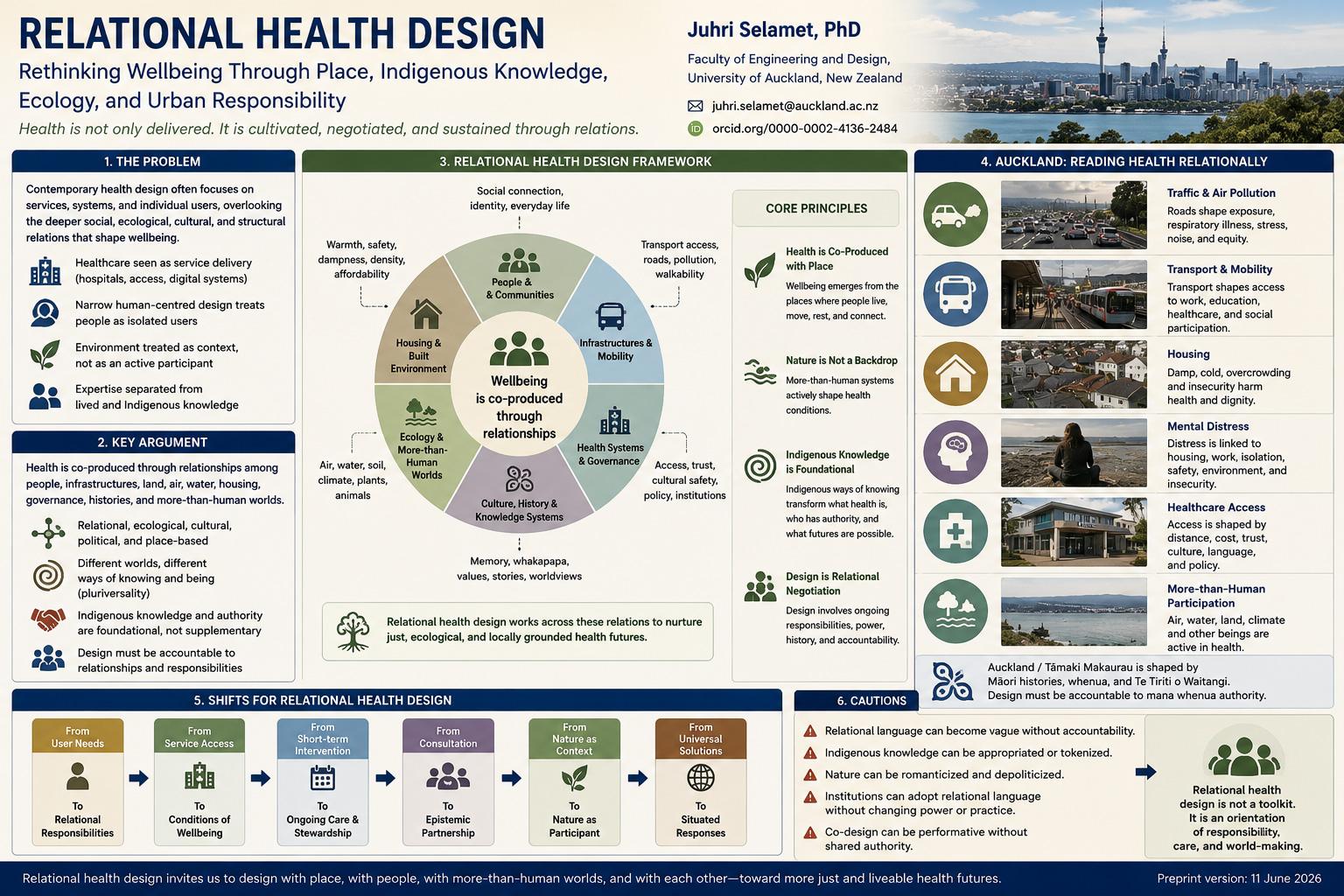
Juhri Selamet’s Relational health design begins from a powerful critique: contemporary health design often treats health too much like a service problem. Public conversations about health commonly focus on hospital capacity, waiting lists, workforce shortages, healthcare access, digital health platforms, patient experience, and clinical efficiency. These issues are real and important. But Selamet argues that when health is framed only through institutions and interventions, deeper conditions of wellbeing become secondary.
The paper’s first important claim is that health is not only something delivered by hospitals, clinics, apps, policies, or service pathways. Health is lived through everyday relations. People become well or unwell through the air they breathe, the houses they inhabit, the streets they cross, the transport systems they depend on, the land and water they relate to, the histories they carry, the institutions they trust or distrust, and the social and ecological systems that shape daily life. In this view, health is relational, ecological, cultural, political, and place-based.
This matters because many design approaches in healthcare have become strongly human-centred. Human-centred design has made important contributions: it has helped designers listen to patients, improve service usability, understand staff workflows, and create more responsive health technologies. Selamet does not reject those contributions. His critique is more precise. The problem is not that human-centred design cares about people; the problem is that it can imagine the human too narrowly, as an isolated user detached from place, culture, ancestry, ecology, infrastructure, and structural power.
For example, a person trying to access healthcare may be described as a “user” of a service. But that person may also be living in damp housing, breathing polluted air, facing transport barriers, caring for relatives, experiencing institutional mistrust, or carrying histories of exclusion from health systems. If design focuses only on improving the booking interface, the waiting-room experience, or the digital pathway, it may improve one part of the system while leaving the deeper relations that produce ill health untouched. Relational health design asks design to look earlier, wider, and more ethically at the conditions through which wellbeing is made possible or denied.
The paper is conceptual in orientation. Auckland is used as a situated urban context, not as a full empirical case study with newly collected field data. This distinction is important. Selamet does not present interviews, surveys, clinical outcomes, ethnographic fieldwork, statistical models, or intervention results. Instead, he uses Auckland to think through broader theoretical tensions in health design. The city becomes an example of how health is shaped by intersecting pressures: housing affordability, traffic pollution, transport dependency, environmental degradation, mental distress, unequal mobility, infrastructure strain, and inequitable healthcare access.
The first major section argues that “health design still thinks in separations.” This is the hidden problem of the paper. Selamet identifies three separations: health from place, humans from nature, and expertise from lived knowledge. These separations are not just intellectual mistakes. They shape how institutions define problems, whose knowledge counts, what evidence is considered legitimate, and what kinds of solutions become imaginable.
The first separation is health from place. Health policy and research often acknowledge that place matters, but place is frequently reduced to a measurable location or background variable. A neighbourhood becomes a risk profile. A street becomes an exposure corridor. A home becomes a housing category. These measurements can be useful, but Selamet argues that they are not enough. Place is not merely a container where health happens. Place participates in the making of health. People breathe, rest, move, remember, gather, suffer, recover, and belong through place.
This is why the paper draws on health geography and therapeutic landscape scholarship. The body is not separate from its environment. A cold house affects respiratory health. A polluted road affects lungs, stress, mobility, and children’s daily exposure. A waterfront or green space may support wellbeing not only through recreation but also through sensory, emotional, cultural, and relational experience. In this frame, health is not only distributed across space; it is produced through lived environments.
The second separation is humans from nature. Selamet argues that dominant human-centred design can unintentionally reproduce anthropocentrism: it centres human needs while treating nature as background, resource, context, or therapeutic add-on. Relational health design rejects that separation. Air, water, soil, plants, animals, climate, roads, housing materials, heat, mould, and pollution are not passive surroundings. They actively shape health conditions.
This point is especially important for public health. A person breathing polluted air is not merely a service user with a health need. That person is part of a damaged socio-ecological relation involving transport policy, road design, emissions, land use, housing location, economic inequality, and environmental justice. Similarly, a child living in damp housing is not only an individual patient who may need asthma care. Their health is shaped by building materials, rental systems, heating, ventilation, income, regulation, and housing governance. Relational health design therefore expands the field of design beyond the clinic, the app, and the service blueprint.
The third separation is expertise from lived knowledge. Many participatory or co-design processes invite communities to share stories, feedback, or experiences, but often after the problem has already been defined by institutions, professionals, researchers, or policy actors. Selamet argues that this can make participation procedural rather than transformative. People may be present in workshops, yet the power to define health, evidence, priorities, and desirable futures remains elsewhere.
This critique becomes especially important in relation to Indigenous communities. The paper argues that design must move from designing for Indigenous peoples to designing with Indigenous peoples. This is not a simple wording change. Designing “for” can still be paternalistic, even when well-intentioned. Designing “with” requires shifts in authority, governance, timeframes, protocols, interpretation, evaluation, and accountability. Indigenous knowledge should not be treated as a cultural supplement to Western design frameworks. It should be recognized as theoretical, generative, ethical, and world-making.
The paper draws heavily on decolonising and Indigenous design scholarship. Linda Tuhiwai Smith’s critique of extractive research is central to this concern. If institutions collect Indigenous knowledge but retain control over interpretation and decision-making, participation can reproduce colonial relations. Tuck and Yang’s warning that “decolonization is not a metaphor” is also important. Selamet uses this warning to argue that design cannot simply adopt decolonising language while avoiding land, sovereignty, material accountability, and institutional power.
The next major section turns to Indigenous knowledge, pluriversality, and the question of what counts as health. This is one of the deepest conceptual parts of the paper. Selamet argues that health design often assumes too quickly what health is. It may define health as individual functioning, institutional access, clinical outcome, service efficiency, or behavioural change. But Indigenous knowledge and pluriversal design challenge this narrowness by asking: what counts as health, and according to whom?
Pluriversal design, associated especially with Arturo Escobar, is important because it rejects the idea that there is only one universal model of wellbeing or one universal pathway to better health. Different worlds are shaped by different histories, ontologies, responsibilities, lands, relations, and ways of living. From this perspective, health may be inseparable from land, kinship, memory, spirituality, food, water, ancestry, intergenerational responsibility, and more-than-human relations. If design assumes one universal model of health, it may treat these relations as cultural variations around a dominant biomedical framework rather than as different foundations for understanding wellbeing itself.
This is where Selamet connects health design with world-making. Design is not neutral problem-solving. It helps make some futures possible while marginalising others. A digital health service, urban plan, transport policy, hospital system, housing intervention, or community engagement process does not merely respond to reality; it helps shape the world in which health is defined and experienced. Therefore, relational health design must ask which worlds design sustains, whose futures it supports, and whose knowledge is given authority.
Indigenous knowledge deepens this challenge because it does not separate knowledge from relationships, ethics, land, and responsibility. The paper draws on Shawn Wilson’s concept of relational accountability: knowledge is produced through relationships, and relationships carry obligations. In this view, a designer cannot simply extract insights from a community and translate them into a solution. The designer is already part of a web of relations and must remain accountable to those relations.
The paper’s discussion of Indigenous knowledge is careful because it warns against tokenism. Indigenous concepts should not be added to a design framework to make it appear inclusive. Māori knowledge, Indigenous methodologies, and relational ways of knowing carry protocols, authority, and place-specific responsibilities. This is especially important in Auckland/Tāmaki Makaurau, where health design must engage with mana whenua, Te Tiriti o Waitangi obligations, tikanga, whenua, whakapapa, and Māori relationships with land and water. A relational approach cannot ethically use Māori concepts as abstract design vocabulary while ignoring Indigenous governance and authority.
In Section 4, Selamet directly proposes relational health design. He defines it as a critical and place-based design orientation that understands health and wellbeing as emerging through relationships among people, communities, infrastructures, ecological systems, Indigenous knowledge, and more-than-human worlds. This is not presented as a step-by-step method or toolkit. It is an ethical and conceptual orientation.
The first principle is that health is co-produced with place. Health does not belong only inside bodies or institutions. It is shaped through housing, transport, land, air, water, neighbourhoods, social relations, and memory. For design practice, this means that a health intervention should not begin only at the level of service access. It should ask what environmental, infrastructural, cultural, and political relations are already shaping wellbeing before people reach the clinic or service.
The second principle is that nature is not a backdrop. Nature is not scenery around human life. More-than-human systems participate in health. Air enters lungs. Water shapes cultural and emotional connection. Housing materials contribute to warmth, dampness, mould, and respiratory risk. Roads produce noise, danger, emissions, and social separation. Climate shapes heat exposure and vulnerability. Therefore, relational health design must treat ecological systems as active participants in wellbeing, not external context.
The third principle is that Indigenous knowledge is not supplementary. Indigenous knowledge must not be treated as decorative inclusion, symbolic acknowledgement, or a cultural layer added after the framework is already designed. Selamet argues that Indigenous knowledge can transform what design is, who it is accountable to, and what futures it serves. It can change the understanding of evidence, participation, health, responsibility, and place.
The fourth principle is that design is relational negotiation. Design is not simply solving a problem. It is negotiating responsibilities, harms, histories, possible futures, institutional power, and community authority. This changes the role of the designer. Designers are not neutral experts who enter a context, extract needs, produce a solution, and leave. They are participants in relational systems. They must listen, negotiate, remain accountable, and recognize the limits of their authority.
From these principles, the paper proposes several practical shifts. Design should move from user needs toward relational responsibilities. It should move from service access toward conditions of wellbeing. It should move from short-term intervention toward ongoing care. It should move from consultation toward epistemic partnership. It should move from nature as context toward nature as participant. It should move from scalable universal solutions toward situated responses. These shifts are among the clearest contributions of the paper because they translate the theoretical argument into design language.
However, Selamet is careful not to romanticise relational design. The paper warns that relational language can become vague if it merely means “connection” without specifying power, responsibility, harm, and accountability. It also warns that Indigenous knowledge can be appropriated, nature can be romanticised, institutions can absorb relational language without changing power structures, and co-design can become performative. This is a strong part of the paper because it does not present relational health design as an easy solution. It treats relationality as demanding, political, and ethically risky if used superficially.
Section 5 applies this lens to Auckland. The key move is to read Auckland’s health issues as relational breakdowns. Traffic pollution is not just a transport problem. It links mobility systems, land use, economic priorities, air quality, respiratory illness, and environmental justice. Communities near major roads and industrial zones may experience disproportionate exposure. Therefore, polluted air becomes a relation between infrastructure, inequality, and bodily health.
Transport is also relational. It does not merely move people from one place to another. It shapes access to employment, education, healthcare, social participation, safety, and dignity. Unsafe roads, poor cycling infrastructure, transport dependency, and unequal mobility affect how people participate in city life. A road is not neutral infrastructure; it organises exposure, risk, time, connection, and belonging.
Housing is another major example. Poor housing in Auckland is not only a matter of individual household choice or technical building failure. It emerges from housing policy, land values, speculative development, inequality, overcrowding, rental conditions, and infrastructural neglect. Dampness, cold, and mould become embodied as respiratory illness, fatigue, stress, and diminished dignity. Selamet highlights research showing that Māori and Pacific whānau are disproportionately affected by substandard housing conditions. This makes housing a health issue, an equity issue, and a colonial/social justice issue at the same time.
Mental distress is also treated relationally. The paper does not deny the importance of clinical mental health support. But it argues that distress is often entangled with housing precarity, insecure employment, social isolation, transport barriers, environmental stress, and urban disconnection. If design treats mental distress only as an individual diagnosis or service pathway, it may miss the conditions that produce anxiety, exhaustion, insecurity, and loneliness.
Healthcare access is similarly reframed. Access is not simply whether a service exists. It also depends on geography, transport, institutional trust, cultural safety, affordability, language, time, waiting lists, and historical relations with healthcare institutions. A person may technically have access to a service but still be excluded through distance, mistrust, cost, or culturally unsafe encounters. Relational health design therefore asks what makes care possible or difficult in everyday life.
The Auckland section also emphasizes more-than-human participation. Air, roads, housing materials, waterways, soil, vegetation, and climate are active in health relations. Air pollution travels through roads, homes, lungs, schools, and workplaces. Waterways shape ecological health, recreation, emotional attachment, and cultural relationships with place. Housing materials participate in warmth, mould, and respiratory conditions. This framing expands health design from human service systems to the material and ecological worlds that sustain or harm life.
The paper’s discussion of Māori perspectives in Auckland is especially important. Selamet stresses that Auckland is shaped by Māori histories, whenua, whakapapa, and ongoing Indigenous presence. The Auckland Unitary Plan recognizes mana whenua relationships with ancestral lands, waters, sites, and taonga. Relational health design in Auckland must therefore be accountable to mana whenua authority and Indigenous governance, not merely use Māori concepts as inspirational language.
The paper refers to Te Whare Tapa Whā, the Māori health model that understands wellbeing through interconnected dimensions including whānau, wairua, hinengaro, and tinana. But Selamet warns that even well-known Māori health models should not be extracted from their cultural and relational contexts. They must be engaged through deeper relationships with Māori knowledge systems and values. This caution is essential because mainstream design often risks turning Indigenous concepts into simplified diagrams or checklists.
The paper’s contribution is not empirical measurement but theoretical vocabulary. It gives designers, health researchers, urban planners, and public health thinkers a way to name the relations that conventional health design often separates. It critiques narrow human-centred design, bridges health design with more-than-human and ecological design, positions Indigenous knowledge as foundational rather than supplementary, and proposes a place-based vocabulary for more accountable design futures.
The strongest aspect of the paper is its ethical clarity. It does not simply argue that designers should include more stakeholders or consider the environment. It argues that health design must reconsider its assumptions about health, evidence, participation, authority, nature, place, and responsibility. This is a deeper challenge than adding community workshops or green spaces to existing systems.
The main limitation is that the paper is theoretical. It does not present a tested relational health design intervention, community-led design process, policy implementation, clinical evaluation, or measured health outcome. Auckland is used as a situated context, but the paper does not conduct a full empirical case study of Auckland residents, health services, mana whenua processes, transport systems, or housing interventions. Therefore, the framework needs future practice-based, Indigenous-led, community-led, and place-specific research.
Another limitation is that relational health design may be difficult to operationalize. Because it resists universal toolkits, it requires careful adaptation to each place. This is conceptually appropriate, but it creates practical challenges for institutions that prefer scalable models, measurable indicators, and standardized procedures. Selamet’s answer is not to reject measurement or implementation, but to warn that scale and standardization can become harmful when they erase local histories, obligations, and relations.
The article is valuable because it helps readers understand that “health design” should not only mean better hospitals, smoother service journeys, or more efficient digital tools. Those things matter, but they are not enough. To design for health means designing the relations that make life liveable: warm housing, breathable air, safe movement, cultural belonging, ecological care, institutional trust, Indigenous authority, and community responsibility.
The final message of the paper is clear: health is not simply delivered. It is cultivated, negotiated, sustained, damaged, and repaired through relations. Relational health design asks designers to become accountable to those relations. It does not offer a universal formula. It offers a demanding orientation: design must work with place, power, memory, culture, ecology, and responsibility if it wants to contribute to just and liveable health futures.
Source and Method Note
The source analyzed here is Relational health design by Juhri Selamet, PhD, from the Faculty of Engineering and Design at the University of Auckland, Auckland Central, New Zealand. The PDF lists the author’s email, ORCID, academic biography, and preprint version dates: 28 May 2026 as uploaded and 11 June 2026 as updated and edited.
The source type is best described as a preprint / conceptual theoretical manuscript. The PDF does not clearly provide a DOI, journal name, acceptance statement, conference proceeding details, volume/issue information, or explicit peer-review confirmation. Therefore, the peer-review status is not clearly peer reviewed. The work should be read as conceptual preprint evidence rather than as a peer-reviewed empirical health design study.
The paper’s method is theoretical synthesis and conceptual argumentation. It does not present a clinical trial, survey, interview study, ethnography, statistical analysis, experimental design, design prototype, controlled intervention, or policy evaluation. Auckland is used as a situated urban context through which broader conceptual questions are explored. The paper draws on literature from human-centred design, health geography, Indigenous methodologies, decolonising research, pluriversal design, more-than-human design, relational wellbeing, participatory design, Māori health models, public health, housing, transport, and urban wellbeing.
No original dataset, patient group, participant sample, laboratory experiment, clinical cohort, health-service intervention, or quantitative model is reported. The paper’s evidence base consists of conceptual reasoning and published scholarly/policy references. Its claims should therefore be interpreted as a theoretical orientation for design thinking, research framing, and ethical practice, not as measured proof that a specific relational health design intervention improves clinical or public health outcomes.
The PDF does not contain empirical figures, data tables, statistical charts, formulas, or experimental diagrams. The document is primarily text-based. Page 1 presents the title, author details, affiliation, and preprint version information. Page 2 presents the abstract and keywords. Pages 2–4 introduce the critique of overly narrow human-centred health design and position Auckland as a situated urban context. Pages 4–9 discuss the hidden separations in health design: health from place, humans from nature, and expertise from lived knowledge. Pages 10–14 discuss Indigenous knowledge, pluriversality, and the question of what counts as health. Pages 14–20 propose relational health design and its core principles. Pages 20–24 read Auckland relationally through traffic pollution, transport, housing, mental distress, healthcare access, more-than-human participation, and Māori perspectives. Pages 25–28 discuss contributions, limitations, and conclusions. Pages 28–35 list references.
Any theoretical concepts discussed in this article, including relational accountability, pluriversal design, more-than-human design, Indigenous knowledge, Māori health, and place-based wellbeing, are provided for explanatory and educational purposes. This article is not medical advice, clinical diagnosis, public health policy order, legal advice, urban planning approval, engineering certification, Indigenous governance authorization, official Māori knowledge interpretation, or institutional healthcare recommendation.
Because the source is a preprint and not clearly peer reviewed, its conclusions should be interpreted carefully. Its strongest value is as a conceptual vocabulary for rethinking health design beyond narrow service improvement and individual user-centred models. Future work should test, revise, and ground the framework through Indigenous-led, community-led, place-based, and empirically accountable design practice.