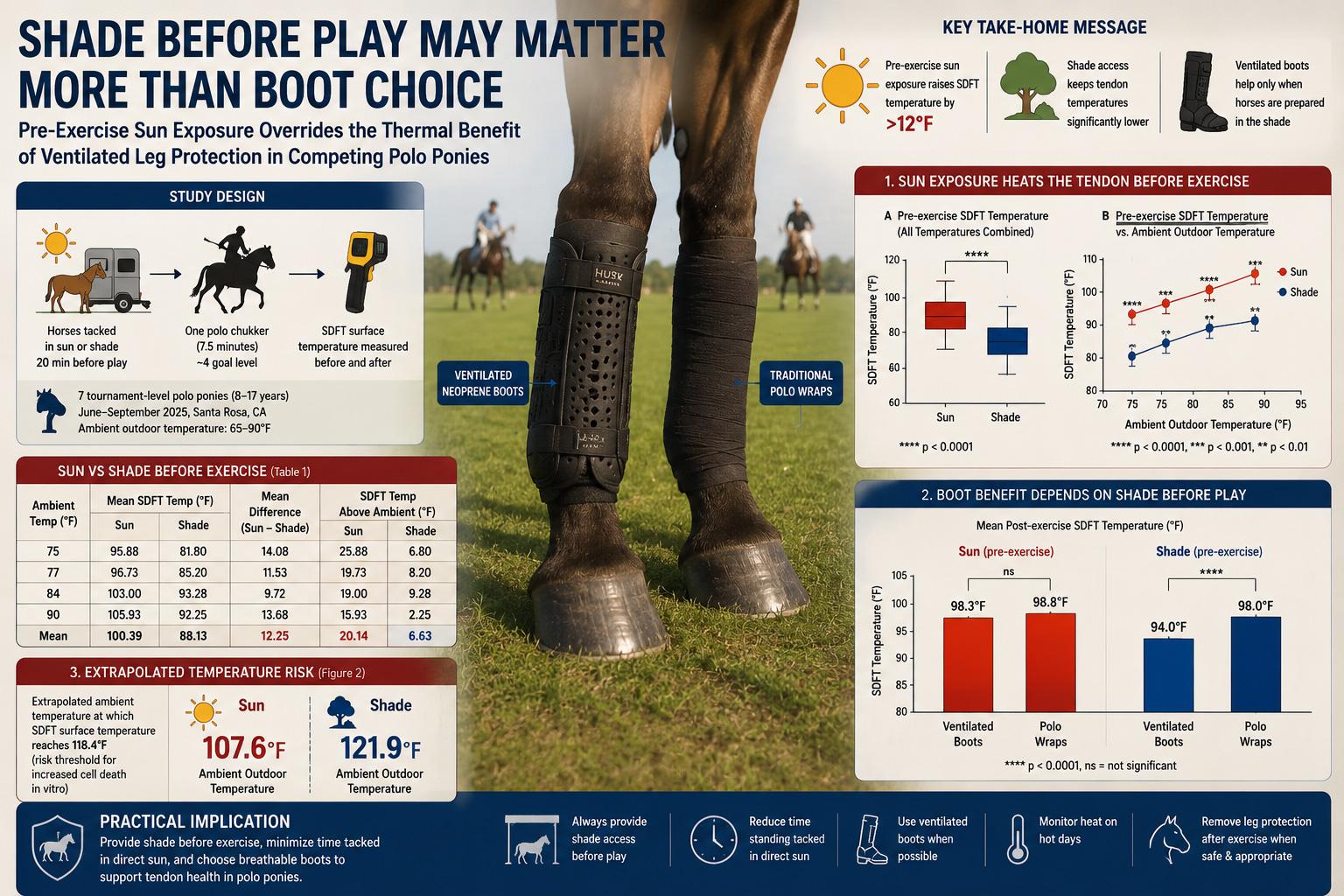
A non-peer-reviewed preprint study examines how pre-exercise sun exposure and two types of leg protection affect the surface temperature over the superficial digital flexor tendon (SDFT) in competing polo ponies. The researchers compared ventilated neoprene boots with traditional polo wraps and found that shade access before play strongly influenced tendon-region temperature. Horses standing in direct sun before exercise had much hotter SDFT surface temperatures than horses standing in shade, even before leg protection was applied or the chukker began.
The main practical message is clear but must be interpreted cautiously: in this small preprint study, pre-exercise sun exposure appeared to override the thermal advantage of ventilated leg protection. When horses were tacked in the shade, ventilated neoprene boots were associated with cooler post-exercise SDFT surface temperatures than polo wraps. But when horses stood in direct sun before play, post-exercise SDFT temperatures were similar regardless of whether the horse wore ventilated boots or traditional wraps. The study therefore suggests that shade access should be treated as a central part of polo pony heat-management and tendon-welfare practice, not as a secondary comfort detail.
This study investigates a practical welfare problem in polo: the superficial digital flexor tendon is vulnerable to injury, polo places intense mechanical demands on the distal limb, and common leg-protection practices may affect heat dissipation. The superficial digital flexor tendon, often abbreviated as SDFT, is a major tendon running down the back of the horse’s lower limb. In high-speed equine sports, it is exposed to repeated loading, stretching, and heat generation. Polo is especially demanding because horses do not simply run in a straight line; they gallop, stop, turn sharply, accelerate again, and physically ride off other horses shoulder-to-shoulder.
The authors begin from an important clinical and management concern: tendon injuries are reported as the most common type of injury in polo ponies, and the SDFT is particularly prone to damage. The introduction cites previous work reporting that 10.6% of polo horses experience injuries requiring veterinary treatment, and that nearly half of polo ponies in one study had SDFT lesions even while presenting as sound. This background matters because it means tendon risk is not only a problem after obvious lameness appears. Damage or degeneration may develop before a horse visibly looks unsound.
The study’s central question is not simply “Which boot is cooler?” It asks a more management-relevant question: does the thermal effect of leg protection depend on whether the horse stood in the sun or shade before exercise? This is a strong practical framing because polo ponies are often trailered to a field and tied near trailers before and after playing. In real polo settings, shade may be inconsistent or unavailable. A horse can stand in direct solar radiation for a meaningful period before leg protection is applied, before the rider mounts, and before the chukker begins. That pre-exercise condition may set the thermal baseline from which exercise-induced heat begins.
The reason this matters biologically is that tendon tissue can be sensitive to heat. The paper cites previous research showing that tendon temperatures in galloping horses can reach 43-45°C, equivalent to about 109.4-113°F, even without leg protection. It also cites in vitro evidence that equine SDFT fibroblast death increases substantially when exposed to 48°C, or 118.4°F, compared with 45°C. Fibroblasts are tendon-maintenance cells; they help preserve and repair tendon structure. If repeated heat exposure contributes to cell stress or death, it could theoretically contribute to long-term tendon degeneration. The current study does not directly measure tendon-cell death, but it uses this prior biological threshold to interpret why high SDFT temperatures may matter.
Previous studies on boots and bandages had already shown that some forms of leg protection can increase skin temperature over the metacarpal tendon region. However, the authors argue that much of that work was conducted in cool climates, below 7°C or 44°F, and under exercise conditions that were milder than polo. This study therefore attempts to examine tendon-region heating under warmer outdoor conditions and in a sport where the exercise intensity is high. That is the study’s main contribution: it places leg-protection temperature questions into a more realistic polo-management context.
The study used seven polo ponies aged 8, 9, 9, 11, 13, 15, and 17 years. All were described as healthy, sound, fit to play tournament-level polo, and part of the same organization. They were trained on the same schedule and followed approximately the same diet. This shared background helps reduce some variability, but the small sample size remains a major limitation. Seven horses can provide useful pilot evidence, but the findings need replication in larger and more diverse polo populations.
The study was conducted in Santa Rosa, California, from June 1 to September 1, 2025. Ambient outdoor temperature ranged from 65°F to 90°F. The authors measured SDFT temperature using a FLIR TG54-2 spot infrared thermometer. Measurements were taken over the same region of the SDFT, midway down the cannon bone, from about 12 inches away. Each measurement was taken twice and averaged. After the horse completed a chukker, the leg protection was immediately removed and temperature was measured again using the same procedure.
This method is practical and non-invasive, but it is important to understand what it measures and what it does not measure. The study measures surface temperature overlying the SDFT, not direct core tendon temperature. Surface thermography and infrared temperature measurement can be useful proxies, and the authors cite prior work supporting this approach, but they cannot fully capture heat inside the deepest part of the tendon. The core of the tendon may behave differently from the surface, especially during intense exercise. Therefore, the study’s results should be interpreted as tendon-region surface temperature evidence rather than direct proof of internal tendon-cell temperature.
The study compared two types of leg protection. The first was traditional black polo wraps made from a fleece and polyester blend. The second was HUSK Irenita Total Air Sport Boots, described as ventilated neoprene/perforated boots marketed as using a lightweight airflow fabric and perforated outer shell to improve ventilation. Leg protection was applied 20 minutes before exercise to mimic common polo practice. This timing is important because the horse is not only wearing the protection during exercise; the leg is already covered before the chukker begins.
Each horse played one full chukker lasting 7.5 minutes. The chukkers averaged a 4-goal total team handicap and required galloping, stopping, turning, and riding off other horses. All horses were ridden by the same rider, Jens Lermusiaux, a 16-year-old male with a 0-goal outdoor handicap. Using one rider may reduce rider-related variability, although it also means the results reflect one rider’s style, weight, riding decisions, and match context.
The first major result is that direct sun exposure strongly increased pre-exercise SDFT surface temperature. Before exercise and before leg protection effects could be evaluated, horses standing in the sun already had much hotter SDFT-region temperatures than horses standing in the shade. The abstract states that, at a single ambient outdoor temperature, horses standing in the sun had SDFT temperatures more than 12°F higher than horses standing in shade before leg protection was applied or exercise performed. This is the core finding: heat risk can begin before the horse moves.
Figure 1 on page 4 is central to the study. Panel A uses box-and-whisker plots to compare SDFT temperatures in sun versus shade before exercise, with n=40 measurements and a very small p-value reported as p=8.99 × 10^-14. Panel B plots pre-exercise SDFT surface temperature against ambient outdoor temperature and shows positive linear relationships for both sun and shade conditions. The key point is not only that hotter days produce hotter tendon-region temperatures, but that sun-exposed limbs remain hotter than shaded limbs at the same ambient temperature.
Table 1, also on page 4, gives the most concrete numerical picture of the sun effect. At 75°F ambient temperature, the mean SDFT temperature in sun was 95.88°F, compared with 81.80°F in shade, a mean difference of 14.08°F. At 77°F ambient temperature, sun averaged 96.73°F and shade averaged 85.20°F, a difference of 11.53°F. At 84°F, sun averaged 103.00°F and shade 93.28°F, a difference of 9.72°F. At 90°F, sun averaged 105.93°F and shade 92.25°F, a difference of 13.68°F. Across these four ambient temperatures, sun-exposed SDFT temperature averaged 100.39°F, while shaded SDFT temperature averaged 88.13°F. The mean difference was 12.25°F.
The table also compares SDFT temperature with ambient temperature. In sun, the SDFT region averaged 20.14°F above ambient temperature. In shade, it averaged only 6.63°F above ambient temperature. This is a powerful management insight. The surrounding air temperature is not enough to describe limb heat exposure. Solar radiation can make the tendon region much hotter than the air, especially when the limb is standing still and exposed.
The second result uses linear regression to extrapolate when SDFT surface temperature might reach 118.4°F, the prior in vitro threshold associated with increased SDFT fibroblast apoptosis. Figure 2 on page 6 shows two lines: one for sun and one for shade. The sun regression is given as y = 0.6931X + 43.79, and the shade regression as y = 0.7428X + 27.84. Using these equations, the authors estimate that the SDFT surface temperature would reach 118.4°F at an ambient outdoor temperature of 107.6°F for horses standing in direct sun, but only at 121.9°F for horses standing in shade.
This extrapolation is scientifically interesting but must be read carefully. It extends beyond the measured ambient range, which was 65-90°F overall and 75-90°F for the table used in the sun-shade comparison. Extrapolating to 107.6°F and 121.9°F assumes the same linear relationship continues at higher temperatures. That may or may not be true. Wind, humidity, coat color, limb color, sweat, movement, surface reflectance, and thermoregulatory changes could alter the relationship. The figure should therefore be treated as a risk-modeling argument, not as a confirmed biological cutoff for polo ponies in all climates.
Even with that caution, the comparison highlights a gap in simple heat-management guidance. The paper discusses the United States Polo Association heat-index guidance, which focuses on the sum of temperature and humidity. That guidance is useful for whole-body heat stress, especially because humidity impairs evaporative cooling. But the authors argue that it may not fully capture local tissue heating of the distal limb under direct solar radiation. A dry 107°F day may not look extreme under some temperature-plus-humidity interpretations, yet the tendon surface in direct sun could theoretically approach a concerning thermal zone. The study therefore asks polo organizations and managers to think beyond air temperature alone.
The third major result concerns leg protection after exercise. The authors compared post-exercise SDFT surface temperature after one 7.5-minute chukker in horses wearing either ventilated neoprene boots or traditional polo wraps. The key finding is conditional: ventilated boots showed a cooling advantage only when horses had been tacked in shade. For horses tacked in shade, ventilated neoprene boots produced a mean post-exercise SDFT temperature of 94°F, while traditional polo wraps produced 98°F. This 4°F difference was statistically significant, with p < 0.001.
However, when horses were tacked in direct sun, the advantage of ventilated boots disappeared. In sun-exposed horses, post-exercise SDFT temperatures averaged 98.3°F with ventilated neoprene boots and 98.8°F with polo wraps. This difference was not meaningful. In other words, direct sun exposure before exercise raised the baseline so much that the ventilation advantage of the boot was effectively lost. This is the study’s title claim: pre-exercise sun exposure overrides the thermal benefit of ventilated leg protection.
Figure 3 on page 7 shows this interaction visually. The red bars represent sun conditions and the blue bars represent shade conditions. In the sun group, pre-exercise and post-exercise conditions are clustered around high temperatures, and the difference between ventilated boots and polo wraps is marked as not significant. In the shade group, the pre-exercise baseline is much lower, ventilated boots remain cooler after exercise, and polo wraps are hotter after exercise. The figure supports the practical conclusion that equipment choice cannot compensate for poor heat-management conditions before play.
This is an important point for daily polo practice. Players may invest in advanced boots marketed as breathable or tendon-protective. Such equipment may indeed reduce heat retention under certain conditions. But if the horse stands in direct sun before playing, the temperature benefit may be largely erased. The study does not say ventilated boots are useless. It says their benefit appears dependent on shade management. The safest practical interpretation is that shade is a foundation, and boot choice is secondary to that foundation.
The study also has a broader message about how sports-equine welfare should be evaluated. Welfare is not only about veterinary treatment after injury. It includes field setup, trailer placement, shade availability, timing of tacking, equipment selection, heat monitoring, and the culture of preparation before competition. If polo ponies commonly stand tied in direct sun, then a modifiable management factor may be increasing tendon-region heat before the horse even begins high-intensity work.
The practical implications are immediate. Polo clubs could provide permanent shade structures, natural shade planning, temporary tents, or trailer awnings. Players could tack horses in shade whenever possible, reduce the time horses stand fully tacked in direct sun, monitor limb surface temperature on hot days, and consider removing leg protection promptly after exercise when safe and appropriate. The study suggests that shade should not be treated as a comfort luxury but as a potential tendon-health measure.
However, this article must not overstate the evidence. The study is small, preprint, and not peer reviewed. It involves seven horses from one organization, one geographic setting, one season, one rider, and one discipline. The exercise exposure was one chukker of 7.5 minutes. Other sports such as cross-country, endurance, racing, show jumping, or repeated polo chukkers may produce different thermal patterns. Horses with different coat colors, limb pigmentation, fitness levels, sweat responses, ages, tendon histories, boot fit, or workloads may respond differently.
Another limitation is that the study does not appear to provide a full randomized crossover design description with detailed control of order effects, horse-level repeated-measure modeling, humidity, wind, solar angle, limb color, boot fit, or exact time standing before measurement beyond the general 20-minute leg-protection application period. These factors could matter. For example, black wraps may absorb more solar radiation than lighter-colored materials. Wind can cool the distal limb. A horse’s stance, hair length, limb color, and previous activity could influence surface temperature. Future studies should model these variables more explicitly.
The paper also reports p-values, but the short manuscript does not provide full statistical-method detail comparable to a longer peer-reviewed experimental paper. Readers should therefore focus not only on statistical significance but also on effect size and biological plausibility. The 12.25°F mean sun-shade difference is large enough to be management-relevant even before formal peer-review scrutiny. The 4°F post-exercise difference between ventilated boots and polo wraps in shade is smaller but still potentially relevant, especially if repeated over many sessions.
The relationship between surface temperature and injury risk also requires caution. The study does not show that horses standing in the sun developed tendon injuries. It does not measure long-term tendon degeneration, ultrasound changes, tendon core temperature, inflammatory markers, fibroblast apoptosis in vivo, or clinical lameness outcomes. It links management conditions to SDFT-region temperature and interprets that link in light of prior research on tendon hyperthermia. That is valuable, but it is not the same as proving injury prevention.
For veterinarians and equine researchers, the next step would be larger controlled studies combining infrared thermography, direct or better-validated tendon-temperature measurement, humidity and solar-radiation recording, repeated chukker exposure, different boot colors and designs, and longitudinal tendon health outcomes. Ultrasound monitoring before and after a season could help test whether repeated heat exposure correlates with structural tendon changes. Laboratory studies could also investigate whether repeated moderate heat spikes, rather than single extreme exposures, affect tendon cells over time.
For polo organizations, the study raises a policy question. Current heat guidance often focuses on ambient temperature and humidity, which are essential for whole-body heat stress. But distal-limb solar heating may require separate guidance. A practical guideline might include shade access before play, minimizing tacked-up waiting time in direct sun, cooling protocols after chukkers, and caution thresholds that consider solar exposure. The study’s authors specifically suggest that USPA-style guidance could benefit from distinguishing between horses provided shade and horses exposed to direct sun.
The study’s everyday lesson is easy to understand: a horse standing still in the sun is not thermally neutral. The lower limb can heat substantially before exercise starts. Once that baseline is elevated, even better-ventilated equipment may not bring the tendon region back into a cooler zone. This principle applies beyond polo. In many animal and human sports, pre-exercise exposure matters. Starting hot makes it harder to stay cool.
The article also has a useful communication value. Many product discussions focus on which boot or wrap is best. This study shifts attention to the environment. Equipment can matter, but management may matter more. A ventilated boot may reduce heat trapping under favorable conditions, but shade access may determine whether that benefit is available at all. That framing respects both the technical role of equipment and the larger responsibility of horse care.
In conclusion, the study suggests that pre-exercise shade access may be one of the simplest and most actionable ways to reduce SDFT-region heat in polo ponies. Ventilated neoprene boots may provide a measurable thermal advantage over traditional polo wraps when horses are prepared in shade, but that advantage appears to disappear when horses stand in direct sun before play. Because the work is a non-peer-reviewed preprint with a small sample, it should be treated as early evidence rather than final guidance. Still, its practical implication is strong enough to deserve attention: before asking which leg protection is cooler, polo managers and players should first ask whether the horse has shade.
Source and Method Note
Source title: Pre-Exercise Sun Exposure Overrides the Thermal Benefit of Ventilated Leg Protection in Competing Polo Ponies.
Authors: Jens Lermusiaux and Caroline Vissers.
Publication / preprint / report status: This is an SSRN-hosted preprint research paper / technical experimental manuscript. The PDF explicitly states that the preprint research paper has not been peer reviewed.
Peer-review status: Not peer reviewed. The findings should be interpreted as non-peer-reviewed preprint evidence and require cautious reading, independent replication, and peer-review evaluation.
Subject area: Equine sports medicine, polo pony welfare, superficial digital flexor tendon temperature, heat exposure, leg protection, exercise physiology, and field-management practice.
Methods used: The study measured surface temperature over the superficial digital flexor tendon using a FLIR TG54-2 spot infrared thermometer. Seven tournament-level polo ponies were assessed under sun and shade conditions, with two types of leg protection: traditional black polo wraps and ventilated neoprene/perforated boots. Measurements were taken before leg protection/exercise and immediately after one 7.5-minute polo chukker.
Dataset and experimental structure: The study involved seven polo ponies aged 8 to 17 years, all from the same organization and considered fit for tournament-level polo. Data were collected in Santa Rosa, California, between June 1 and September 1, 2025, with ambient outdoor temperatures ranging from 65°F to 90°F. The analysis compared SDFT-region temperature in direct sun versus shade and examined post-exercise differences between ventilated boots and traditional wraps.
Figures, tables, and page numbers: Figure 1 on page 4 shows that sun exposure significantly increased pre-exercise SDFT surface temperature and that SDFT temperature increased linearly with ambient outdoor temperature in both sun and shade. Table 1 on page 4 reports mean SDFT temperatures at ambient temperatures of 75°F, 77°F, 84°F, and 90°F, showing a mean sun-shade difference of 12.25°F. Figure 2 on page 6 extrapolates SDFT temperatures up to ambient temperatures of 125°F and estimates that a 118.4°F risk threshold would be reached at 107.6°F in sun versus 121.9°F in shade. Figure 3 on page 7 shows that ventilated neoprene boots were associated with cooler post-exercise SDFT temperatures than polo wraps in shade, but not when horses were prepared in direct sun.
Formula and statistical explanation: The paper uses linear regression equations to extrapolate SDFT surface temperature from ambient outdoor temperature. The reported regression lines are approximately y = 0.6931X + 43.79 for sun and y = 0.7428X + 27.84 for shade, where X represents ambient outdoor temperature and y represents extrapolated SDFT temperature in °F. These equations are explanatory models based on the study data and should not be treated as universal biological laws.
Important caution: This article is an explanatory interpretation of a non-peer-reviewed preprint. It is not veterinary medical advice, not a diagnosis, not a treatment recommendation, not an equine safety certification, not a sports regulation, not legal advice, not investment advice, not an engineering approval, not a religious ruling, and not an official policy order. Decisions about polo pony health, training, leg protection, heat exposure, and injury prevention should be made with qualified veterinarians, equine professionals, and appropriate welfare oversight.